
Six months after it warned 97 automotive dealer groups, the FTC published its pricing FAQs: the advertised price is the price any buyer can pay, and everyone who controls the ad answers for it, including the listing sites and the manufacturers. That closes a fight dealers had been having alone, in every vehicle segment. It also ends the marketplace price game that made honest online selling impossible.
On September 15 the Federal Trade Commission published fourteen questions and answers on automobile pricing transparency. It landed six months and two days after the agency sent warning letters to 97 automotive dealer groups, among them the largest publicly traded retailers in the country, and it is the document dealers and their trade associations had been asking for since March. NADA called it an important step toward clear guidance for its members. I wrote about the letters in April, in the end of the price-on-the-windshield era. This is the follow-up. The FAQs answer a question the letters left open, and the answer changes who is in the room, whether you sell cars, trucks, motorcycles, RVs, boats or golf carts.
What the FTC actually said
Most of the document restates a standard the agency says has been in effect for decades.
“The FTC Act requires that the advertised price be the actual price any consumer can walk in and pay.”
The only charges you can leave out are the ones a government requires the consumer to pay: sales tax, title, registration, license. Everything the dealer requires goes in, including fees a state authorizes but does not mandate, and fees the state charges the dealer that the dealer passes along.
The FTC wrote its own worked example. A $40,000 vehicle with an $85 doc fee is advertised at $40,085. If some buyers are quoted $85 and others are quoted more, the advertised price carries the higher fee, because the number has to hold for whoever walks in next.
The remaining answers cover where the rule applies, which is every place a price appears: your website, your search results and vehicle pages, social, print, the roadside sign, and whatever your staff say on the phone or in a text. MSRP, rebates and conditional discounts can still appear, as long as the actual price is the most prominent number, and prominence is judged on placement and attention, not font size alone. A $2,000 discount for financing through the store is fine when the $39,999 any buyer pays sits above it. State doc-fee disclosures stack on top of the federal requirement. Sold units come down. A unit in transit says so.
Question 13 asks how long dealers have to come into compliance. The answer is that the requirement is not new, and anyone misleading consumers about price is risking FTC action. There is no grace period.
The question the letters left open
The fight since March has not really been about whether all-in pricing is right. Most dealers I talk to agree that it is. The fight has been about who is left holding the bag, and it has run on two tracks.
In automotive, the manufacturer’s number already carries freight, because federal law has put destination on the window sticker since 1958. The argument was about the store’s own fees, doc, add-ons, conditional discounts, and about the third parties that display the price. A dealer sends a feed to the listing sites, the site decides how the number displays, and the store gets the letter.
A dealer at one multi-store group told Car Dealership Guy in March that the letter felt like it was meant to scare, at a group that already spends over a million dollars a year on compliance. The listing sites answered before the FTC did.
CarGurus gave dealers until July 14 to disclose fees or lose their deal ratings and slide down the results, and more than 90% of its listings now carry disclosed fees. Cars.com, Autotrader, TrueCar and Carfax have all changed how they display total price or badge listings where fees are included. The FTC’s consumer protection director put the principle in one line in June: “If you can control what’s in the ad, then you’re responsible for it.”
In powersports, and in a good share of RV and golf cart retail, the argument was about the manufacturer. The MSRP the factory publishes leaves out freight. The dealer pays the freight, uncrates the unit, assembles it, runs the PDI, and recovers all of it as line items the buyer reads as dealer markup. Then a federal agency tells the dealer the price on their VDP is deceptive. The National Powersports Dealer Association put this in a white paper on April 23. It asked manufacturers to build freight into MSRP the way the automotive industry builds destination into the Monroney label, and to reimburse dealers for the setup work they require. Michael Maledon, who sits on the NPDA board, put the dealer side in one sentence: “Dealers did not create this problem, but they are the ones being held accountable.”
Mark Sheffield, who sits on the same board and advises Woods Cycle Country in Texas, raised the issue with me at the end of our NPDA video feature in July. He had configured a motorcycle on a manufacturer’s own website, every option, all the way to a final price, and freight appeared nowhere. The manufacturer was advertising a number no buyer could pay in the field. He also pointed out that the same manufacturers already publish all-in prices in Canada, where the law requires it, so the argument that it cannot be done here did not hold up for him. Mark called my first answer on the call a non-answer, which was fair. Ekho is the transaction layer and we sell to both sides of this, so I was walking down the middle of the aisle. This piece is my attempt at a more useful answer: a plain reading of what the FAQs say and what they change. Whatever you think of the standard, we are glad the document exists, because dealers now know what to do.
Question 12 of the FAQ takes the responsibility question on directly.
“Everyone who has control over the advertising is responsible for making sure ads state the actual price as the most prominent amount.”
It then names three parties. Dealers have to advertise accurate prices, hand the actual price to any third party, and make sure nobody at the store gives contradictory instructions. Third-party advertisers have to display that price most prominently. OEMs “should make sure none of their policies or practices conflict with these requirements.”
Michael read that as confirmation of the NPDA position, that responsibility does not rest solely with dealers, and he is right. It is the first time the agency has written the manufacturer into the sentence. The other half matters too. The FAQ leaves the store’s responsibility where it was and adds the manufacturer and the listing site beside it. You still own what your feed sends and what your salespeople say.
Why this is hard to do on short notice
The problem with going all-in first is that you look expensive for as long as your neighbors do not. On a marketplace, a $12,499 listing with freight and setup in the fine print sorts above your $13,449 listing for the same unit at the same real cost, and the sort order does not know the difference. Mark told me on our NPDA video feature that Woods Cycle Country went to one price on July 1, that it put the store at a pricing disadvantage in the marketplace, and that buyers liked it. Every early mover is in that position, and the CarGurus number says a lot of automotive stores are already there.
The hard part is the sequencing. If adoption is staggered, the dealers who move last win leads for as long as they hold out, and the dealers who move first pay for it. That is the arbitrage I worry about for the dealers doing the right thing, and it is why the standard has to land on everyone in the same season. The FAQ shortens the window, because it removes the argument that the standard was unclear. The marketplaces shortened it first, and an honest listing loses less ground on them every month.
The third change has to come from the manufacturers, and Mark Sheffield, in our NPDA interview feature, put it well: including freight in MSRP is not a windfall for dealers. Any short-term margin gets competed away and the industry settles back to the margin it already runs on. What changes is that the buyer stops meeting a second price at the desk, and the dealer stops defending a charge they did not design. If you sell a brand whose MSRP excludes freight, the most useful thing you can do this quarter is tell your rep, in writing, that the FTC has now addressed manufacturers directly. Mark’s version in his Powersports Business column was shorter: call your reps, email your reps, text your reps.
The price game this ends
The pattern the FAQs are aimed at is the same pattern that kept online vehicle sales from working for a decade. Marketplaces became a price war. The lowest number won the lead. The margin came back at the desk, through freight and setup and doc, through accessories that were already bolted to the unit, and through an F&I menu that had to carry more than its share. Nobody at the store had to intend a bait and switch for the buyer to experience one.
That pattern also worked against self-serve online sales. You cannot let a buyer check out at a price you do not intend to honor, so for a dealer who did not yet believe an online channel would be incremental, the marketplace game made the idea less appealing still. Of all the demo calls that did not turn into an Ekho client, the number one objection, historically, has been some version of this: I am not putting my real price on the site, I need the lead in the store first. It was an honest objection. The FAQs remove it. If the advertised price has to be the real price everywhere, the case for making the buyer come in to learn the number is gone, and the case for letting them finish the purchase where they found it gets much stronger.
This is a tailwind for Ekho. It is also a win for the buyer who spent two hours on a Saturday learning that the price was a starting point.
About 75% of buyers who complete a purchase through Ekho’s checkout say they probably or definitely would not have bought at all without the online option.
Those buyers exist in every segment, and a published price they can trust is what gets them to the finish line. I wrote about the structural reasons transparent pricing has been slow to arrive, and why blaming dealers misses the point, in transparent pricing and dealer success. The FTC has moved the incentives, and the structure will have to follow them.
What it looks like when the system has one number
The cleanest way to satisfy the FAQ is to run a system that cannot produce a second number. If the listing, the conversation and the checkout all read from one price and one fee schedule, there is nothing to reveal at the desk. That is how the Transaction Engine was built, and it is why neither the March letters nor the September FAQs changed how it prices a deal.
Some candor about our own top of funnel. Dealers told us this year that the vehicle detail pages and search results we ship could do more to show a buyer what the advertised number includes, and the FAQs made the standard clear enough to act on. We moved quickly after they landed, and the price details on an Ekho vehicle page now read like this.
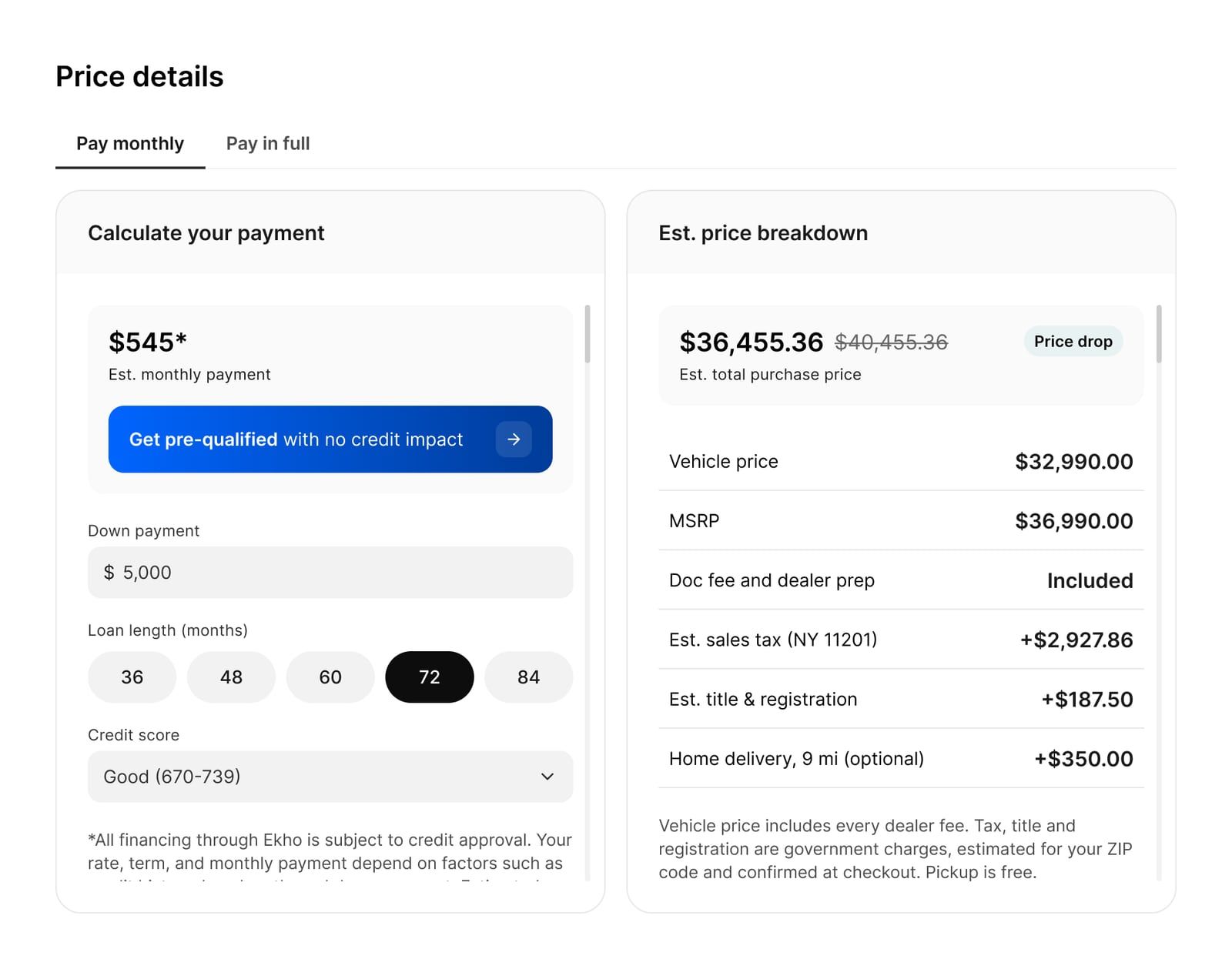
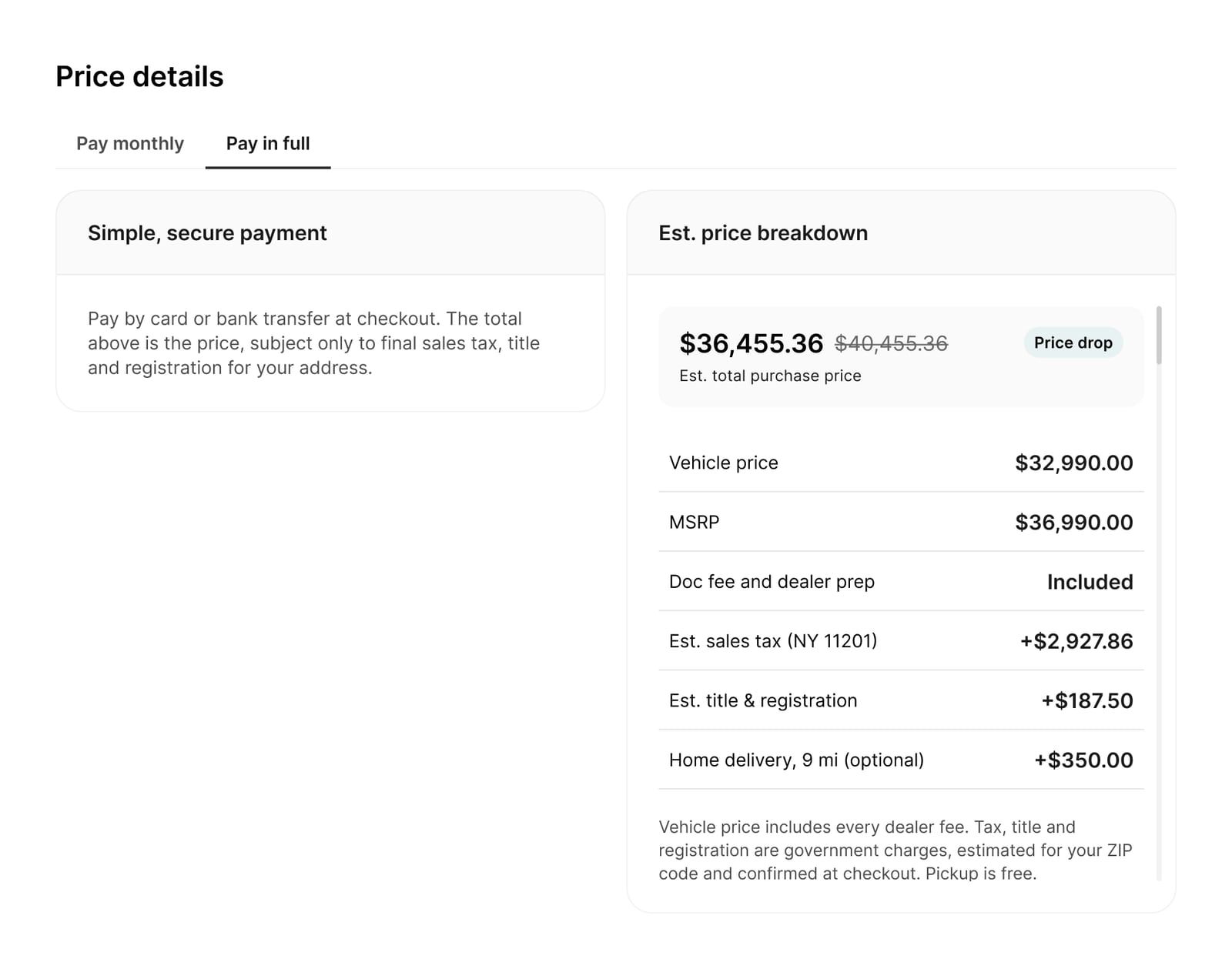
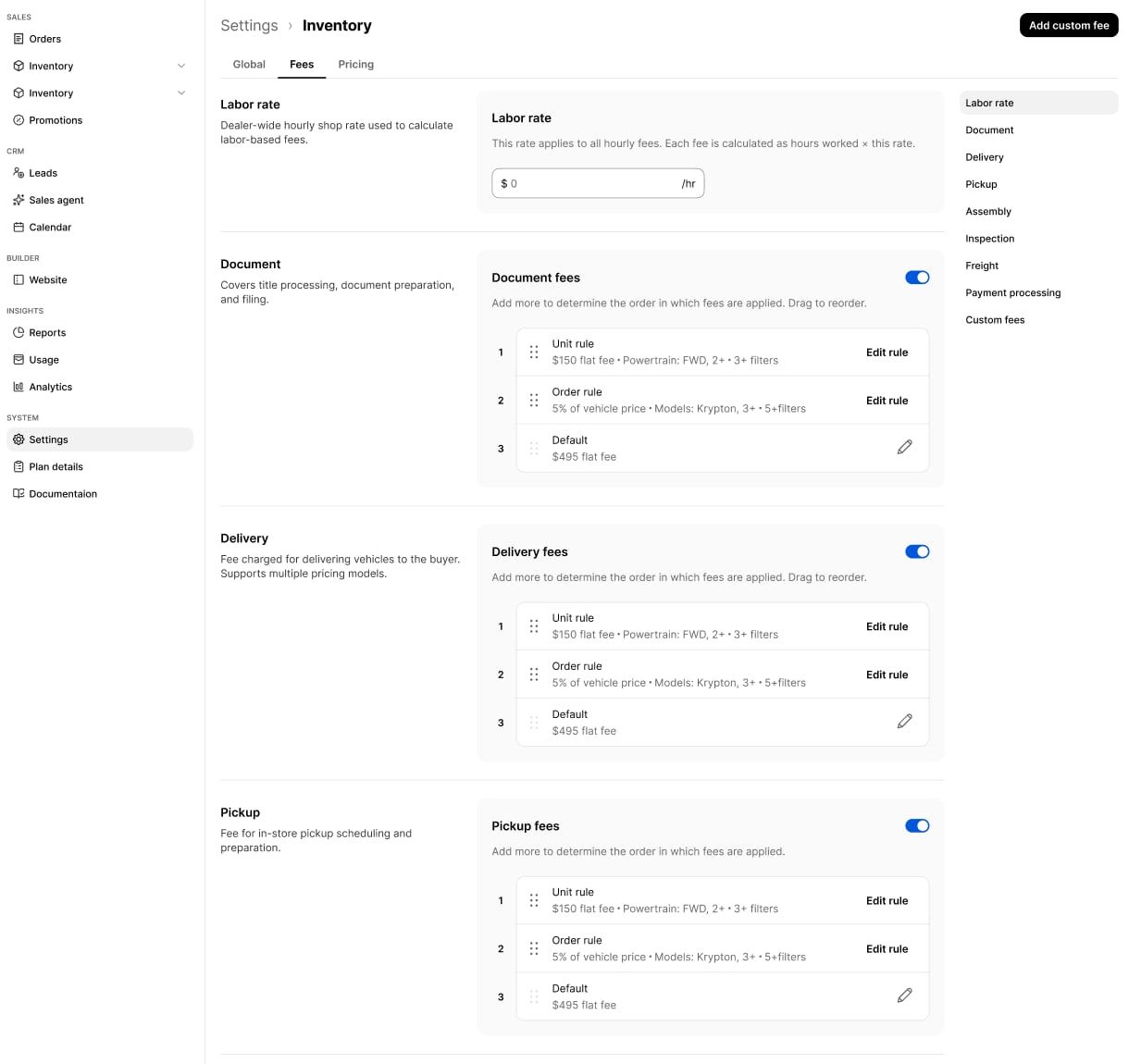
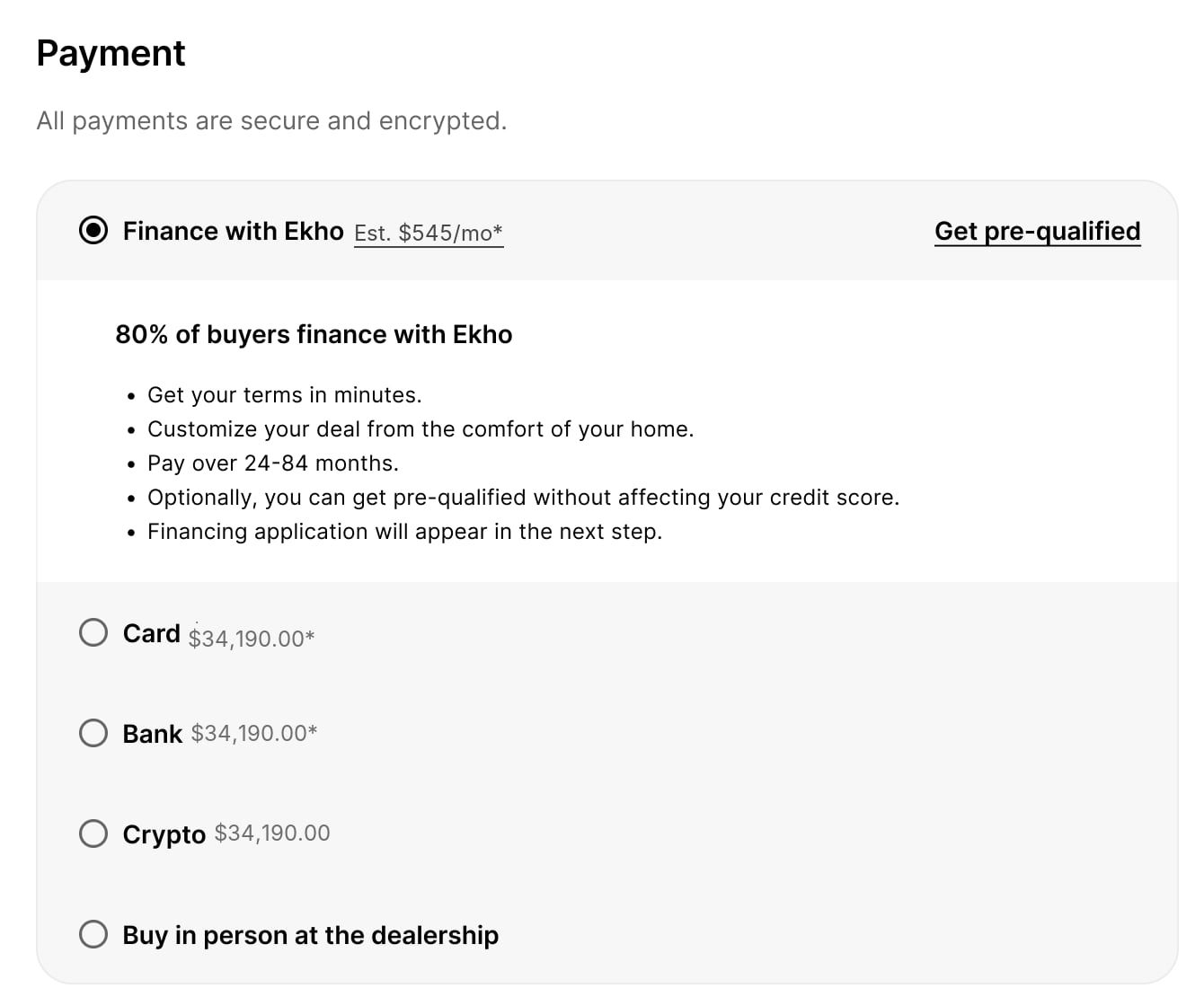
Behind the page, every fee a dealership charges is configured once in the Admin Portal: document, delivery, pickup, assembly, inspection, freight, payment processing, or a custom fee. A dealer group can set a fee at the group level and let each store inherit it or override it with something more specific. A fee can apply to all inventory, or to a slice of it defined by a rule on make, model, powertrain or price band, and the rule keeps matching units that arrive next month. The vehicle page and the checkout read from the same schedule, so the FAQ’s example of one buyer quoted $85 and the next quoted more has no field to live in.
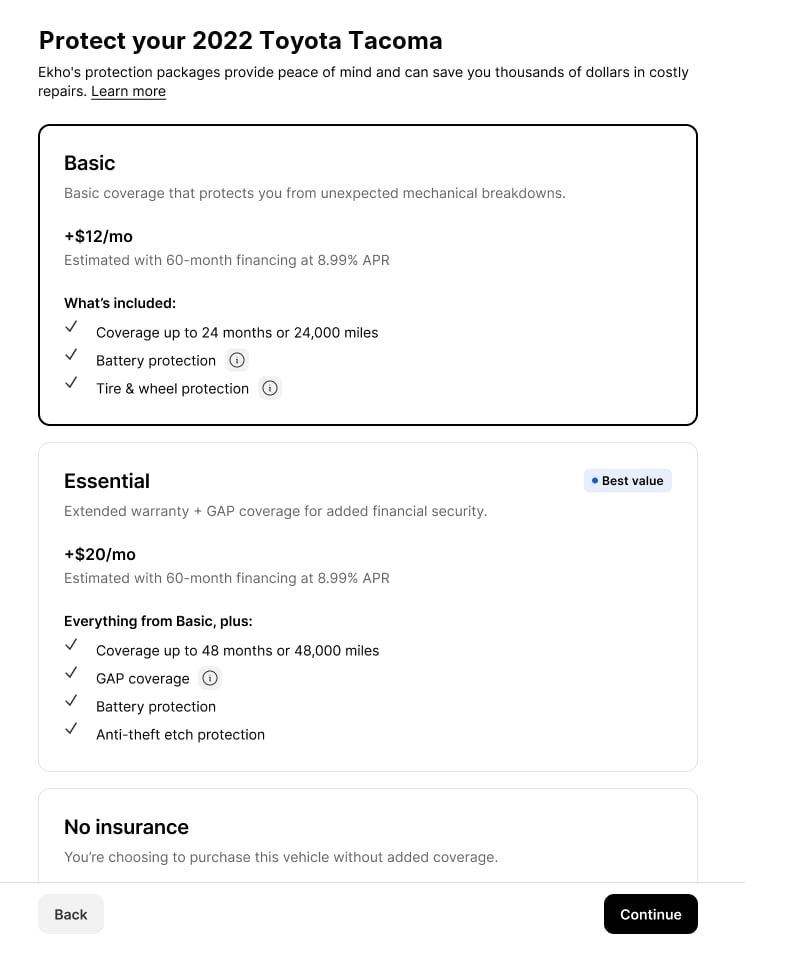
Question 9 of the FAQ is about add-ons: a dealer cannot suggest an option is required, imply an installed item cannot be removed, or charge for something the buyer did not agree to. A menu built the way I argued the menu should be built satisfies that by construction. Each product carries its own price, its optional status and the buyer’s acknowledgement, and penetration on online deals still converges with in-store.
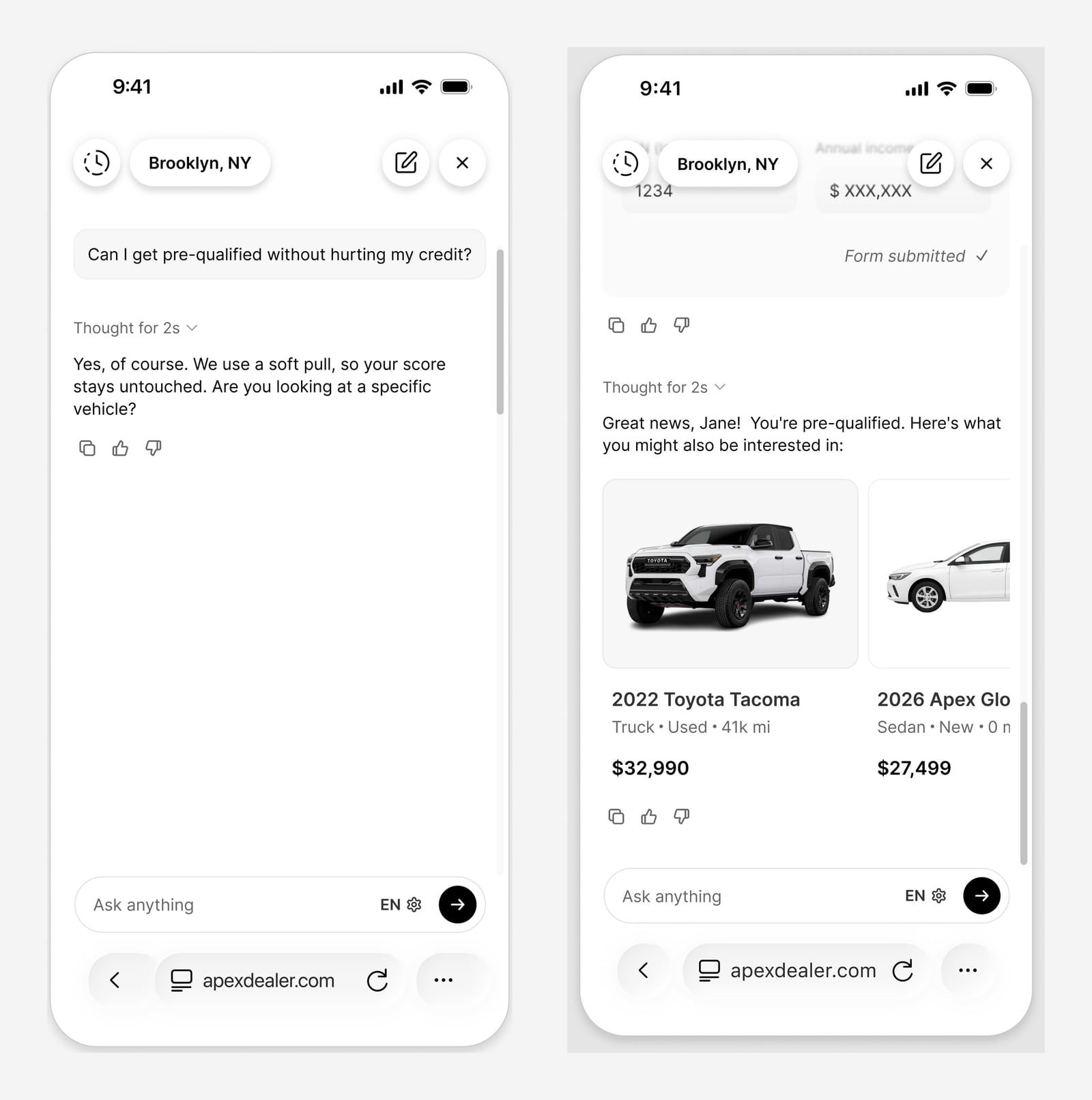
Question 3 says a text message from your staff is an advertisement. The AI Sales Agent answers price questions on web chat and by text with the same number the listing shows, and when payment comes up it offers a pre-qualification. It does not quote a monthly payment. Promotions follow the same logic. A dealer or manufacturer offer is priced into the deal the moment a buyer qualifies, so the number on the vehicle page and the number on the paperwork match. Fees that come to nothing are left off the order and its documents. Sales tax, title and registration are computed for the buyer’s jurisdiction, so an out-of-state quote is a real quote. The mechanics are collected on our out-the-door pricing page.
What to do before the end of the month
- Put the doc fee in the number. The FTC wrote the example itself. If your fee varies, advertise the highest one.
- If freight, destination, setup, PDI or reconditioning are mandatory on a unit, they are in the price. Say “freight and setup included.” Do not say “no freight fees,” which is a different claim, and one NPDA’s counsel flagged as deceptive in May.
- Check your own SRP and VDP for prominence. Actual price largest, MSRP smaller, a strike-through is fine, and no label that leaves a buyer unsure which number they pay.
- Audit every feed. Pull your listings on each marketplace and confirm the number matches your site and includes your fees. Turn on the fees-included setting where the platform offers one. Counsel who work these cases say the agency pulls listing-site data in an investigation, so your feed is the record.
- Give the phone and text scripts the same number. Question 3 names both.
- Remove sold units the day they sell. “Pending” and “deposit taken” do not protect a listing. Label in-transit units as in transit.
- If you carry a brand whose MSRP excludes freight, write to the rep this week and cite question 12.
The list is the same whether you sell passenger cars and trucks, side-by-sides, travel trailers, boats or golf carts. The FAQ is addressed to automobile dealers. Section 5 of the FTC Act, which it rests on, applies to anyone who advertises a price for anything.
See how the Transaction Engine keeps one price from the vehicle page to the signed contract on our out-the-door pricing page.
Frequently asked questions
FTC staff published fourteen questions and answers on automobile pricing transparency. They restate that the advertised price must be the actual price any consumer can walk in and pay, excluding only charges a government requires the consumer to pay, and they cover doc fees, MSRP and discounts, web listings, third-party advertisers and OEMs, in-transit and sold units, and the absence of any grace period.
Yes. The FTC’s own example is a $40,000 vehicle with an $85 doc fee, which must be advertised at $40,085. If the dealer charges different doc fees to different buyers, the advertised price has to reflect the highest fee any buyer would be required to pay.
Everyone who has control over the advertising. The FAQ says dealers must advertise accurate prices, give the actual price to third parties and take the steps within their control to have it shown most prominently. Third-party advertisers must display that price most prominently. OEMs should make sure none of their policies or practices conflict with the requirement.
Yes, as long as the actual price any consumer can pay is the most prominent amount and the terms of the discount are clear. Prominence is judged on placement and attention as well as font size, so an MSRP in a smaller font that sits where the eye lands first can still be a problem.
The FAQs are addressed to automobile dealers, but they rest on Section 5 of the FTC Act, which applies to anyone advertising a price. NPDA’s counsel has advised powersports dealers to assume the same standard applies immediately, with freight, setup, PDI and doc fees included in the advertised price and only government charges left out.
The comparison a shopper makes is between your total price and the one they can find elsewhere in seconds, and a self-serve online checkout only works against a price the dealer intends to honor. About 75% of buyers who complete a purchase through Ekho’s checkout say they probably or definitely would not have bought without the online option, and a published price they can trust is part of what gets them there.