Dealers are leaking leads they already paid for, and the industry is aging out of its own buyer base. On the NPDA Partner Webinar Series, I walked through the data behind both problems and what dealers can actually do about them. This piece distills that conversation.
Earlier this month I joined Mark Sheffield on the NPDA Partner Webinar Series for a session titled “The Two Problems Killing Powersports Growth (And What to Do About Them).” Mark has spent three decades in this industry: he started on a dealership floor in 1995, spent close to twenty years running and now advising Woods Cycle Country in Texas, facilitated Spader 20 Groups of dealers for nearly a decade, and today advises both the NPDA and the Texas Motorcycle Dealers Association. So this was less a presentation and more a working session between two people staring at the same data from different seats.
The full recording is embedded below, and the timestamped links throughout this post jump straight to the moments they reference. The written version distills the argument for anyone who prefers reading to watching.
Problem one: you’re losing customers you already earned
A customer raises their hand. They fill out a form, ask a question about a unit, or start shopping after dinner. And too often, the response is late, incomplete, or never comes at all.
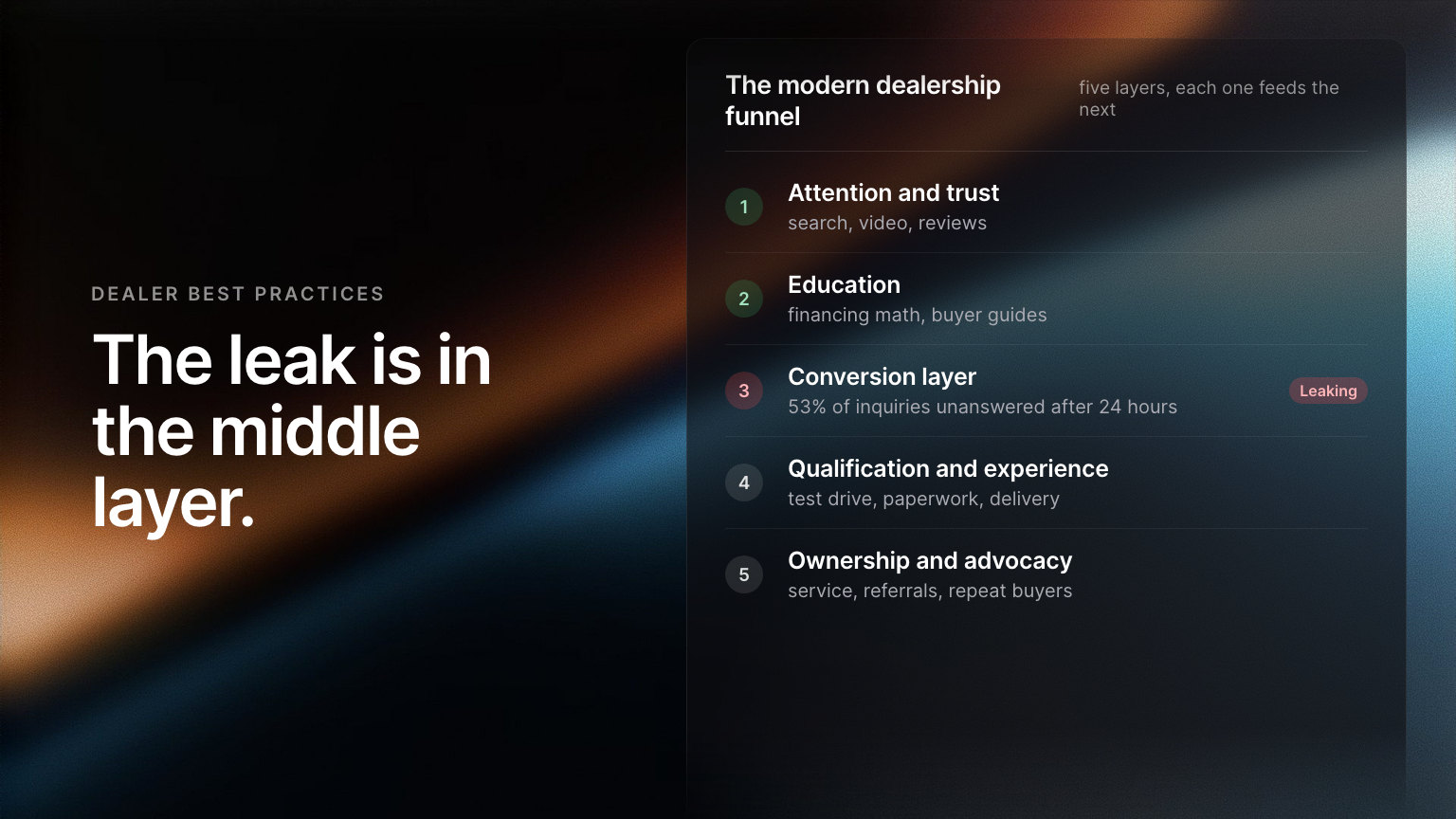
The data here is uncomfortable. Per Pied Piper’s industry studies (16:33 in the webinar), 30% of leads submitted to powersports dealers are never responded to (2024), and 53% of inbound inquiries get no response within 24 hours (2026). Meanwhile, NADA data shows that more than 60% of in-market buyers are browsing after 5 p.m., when the doors are locked and nobody is answering.
Now layer on the stat that ties it together (20:26): 78% of buyers purchase from the first company that responds to them (Lead Connect). Being first isn’t a nice-to-have. It is, statistically, most of the game.
Mark put a decade of ground truth behind those numbers (17:12) on the webinar. He has personally shopped close to 500 dealerships over ten years, and the ghosted rate hasn’t moved:
“It was something that dealers love to talk about. They got all fired up about it, and then they went home and nothing ever changed.”

He eventually stopped training dealers on digital lead response altogether. One of his 20 groups scored a 2.2 out of 10 on lead handling, committed to fix it, and came back to the next meeting worse.
Why the leak never gets fixed
I don’t think this is a people problem. The teams handling these leads are inundated. They eyeball-qualify what comes in, chase what looks hot, and quietly drop the rest. And the majority of shopping activity happens outside business hours, when there is no one to respond no matter how disciplined the process is.
That’s why I think lead response is the single most obvious place to put AI to work in a dealership. Not as an efficiency play that squeezes your existing staff, but as coverage for work that is going untended today. The opportunity is incremental: the after-hours shopper who currently hears nothing, the fifth inquiry of the morning that never gets a callback, the lead that went cold in the CRM eight months ago.
This is exactly what we built the Ekho AI Sales Agent to do. It lives on your website and your texting line, knows your inventory and your store cold, answers in seconds at any hour, and works toward the goals you configure: booking an appointment, running a pre-qualification, estimating a trade. Every conversation is co-assigned to a human rep who can watch, jump in, or take over, and anything the agent can’t handle gets escalated with a summary. Your salespeople still close. They just sit down at 9 a.m. to warm, qualified conversations instead of a stack of cold form fills. I’ve written before about what disciplined automated lead follow-up looks like if you want the deeper playbook.
Mark tried to break it, live
We didn’t run a scripted demo. About twenty minutes in, I pulled up a demo dealership, put the AI Sales Agent on screen, and asked Mark to try and break it. He has sat through more AI demos than almost anyone in powersports, and he came armed with the questions that expose the weak ones.
His first test was the one he uses to break chat tools: get the agent talking about a unit on the site, then ask it to compare against a competing brand (27:23). In his words: “It’s where I broke some other ones, where it starts recommending something else that a dealer doesn’t carry.” The agent searched the store’s live inventory before answering, gave an honest comparison between the Aprilia we were viewing and the Kawasaki Z1100 he named, asked what kind of riding experience the buyer was after, and surfaced the Kawasaki units the store actually had in stock. No invented inventory, and no sending the buyer down the street.
Then he played the buyer: “I’m looking for something that’s going to impress my riding buddies” (28:58). The agent made a real recommendation, called the Aprilia a head turner on any group ride, and kept moving toward qualifying the buyer and booking an appointment instead of dead-ending at a clever answer.
His third test was my favorite: “If I want to order a new one of these, how long would it take to get it?” (31:01). A lesser tool quotes a lead time. The agent answered the way a top-performing sales manager would want it to: instead of ordering and waiting, there are a few brand new ones in stock right now. Mark’s reaction on the call: “That’s good. I’m glad I did that.” The default playbook is butts on seats.
Here is that exchange, recreated in the same conversation widget from what buyers actually say to an AI Sales Agent:
He had one more test, the one he told the audience almost no vendor has passed (32:05): can the dealer see every question customers ask, review the answers, and grade them so the system improves? That loop exists on both ends of the AI Sales Agent. Buyers rate answers inside the conversation, dealers review every conversation in the admin portal, and smart replies let you teach it how your store answers a recurring question.
Problem two: the industry is aging out of its own buyer base
The second problem (10:14) is bigger, and it’s the one that doesn’t show up on any sales report.
According to the MIC Owner Survey, the median motorcycle buyer was 27 years old in 1985, 41 in 2003, and 50 by 2018. The under-25 cohort has collapsed from 24% of buyers to 8%. Every year the industry’s core customer gets closer to their last purchase, and the replacement generation isn’t walking through the door.
It isn’t that younger buyers don’t want what we sell. It’s that they expect to research, compare, finance, and buy with the convenience they get in every other category of their life. When that option doesn’t exist, they don’t grit their teeth and come in anyway. They delay, move on, or never enter the industry at all. Problem one costs a dealership a sale. Problem two costs the industry a rider.
Why “digital retailing” hasn’t fixed this yet
I was candid about this on the webinar (4:27): most of what has been sold as digital retailing is a glorified lead generator. It might run a pre-qualification or syndicate a credit application, but it stops at the handoff. The technology doesn’t help you close the deal, and the buyer who wanted to finish online still ends up doing paperwork in a cubicle.
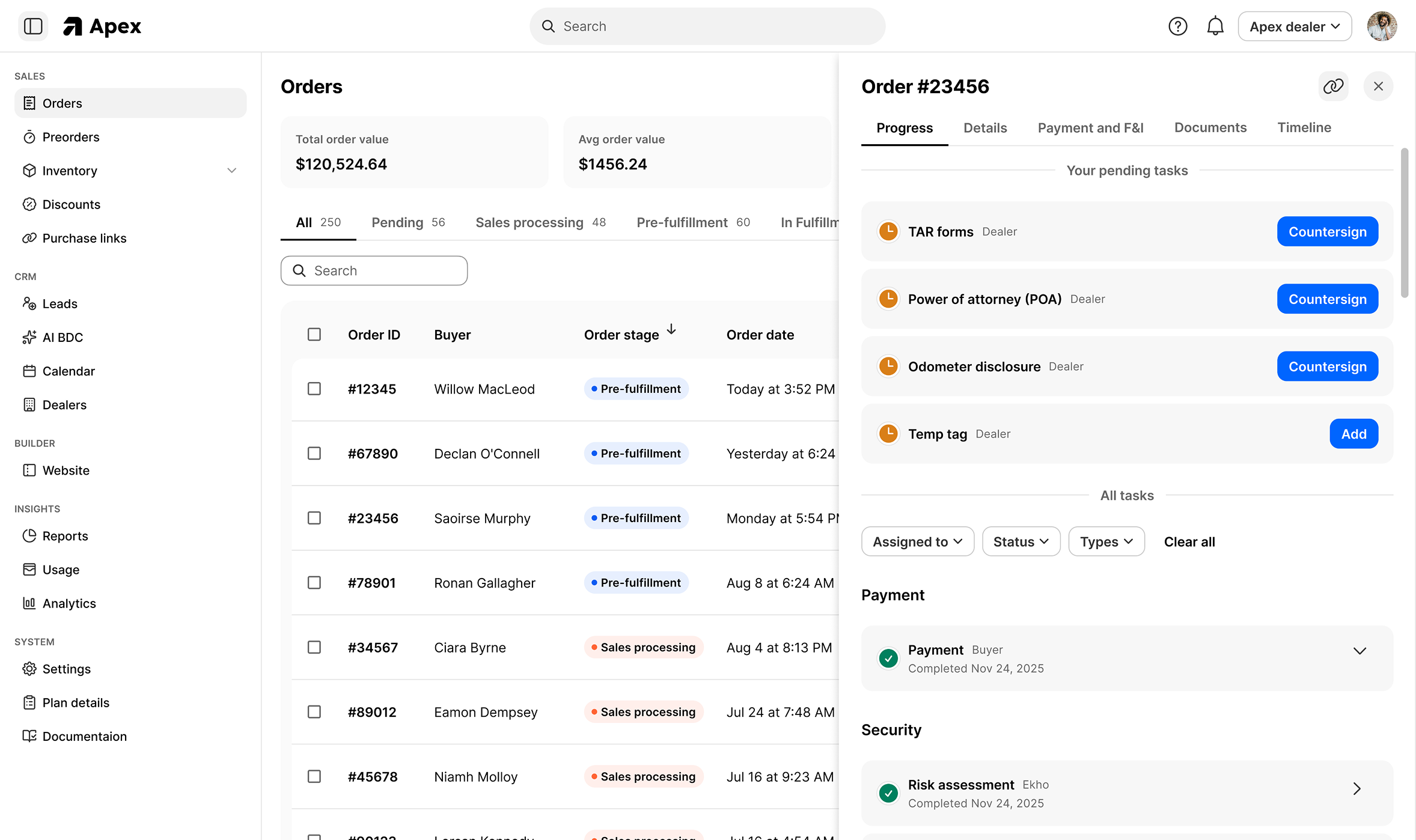
Closing that gap means automating everything after yes (40:50): financing, stipulation clearance, funding packets, titling, registration, insurance verification, signatures, fraud checks, and tax calculation, in all 50 states. That is what the Ekho Transaction Engine does, bolted onto the website you already have, with your team supervising every deal from the admin portal. If you want the mechanics, here’s how selling vehicles online across all 50 states actually works. And once out-of-state titling and fraud stop being reasons to say no, your addressable market stops being a 50-mile radius and starts being the country.
The proof it’s incremental, not cannibalized
The most common objection I hear is that online sales just move deals that would have happened anyway. Our data says otherwise (45:01). In Ekho post-purchase surveys, 70% of online buyers say they probably or definitely would not have purchased without the online option. 88% are younger than the industry’s average buyer, and 40% are buying that vehicle type for the first time (Ekho internal, 2025-2026).
In other words, the people who buy online are largely not the people on your showroom floor. They are the missing generation from problem two. I went deeper on this in capturing customers who don’t want to come in.
Dealers still matter. The path to the showroom changed.
None of this is about replacing the dealer. Mark said it well in his opening: the local relationship still matters, the showroom still matters, but the path to the showroom has changed. The dealers who adapt to that path will capture the customer before someone else does, and give everyone on their team more leverage while doing it. We started Ekho because dealerships deserve better tools, not more tools, and this is what that looks like in practice.
The embedded recording above has the whole conversation, including the live AI Sales Agent demo (21:01) and a spirited Q&A on pricing transparency (59:27). And if you’d rather see it on your own store’s leads, book a demo and we’ll walk one through end to end.
Frequently asked questions
First, dealers are losing opportunities they already earned: 30% of leads to powersports dealers never get a response, and 53% of inquiries get no response within 24 hours (Pied Piper). Second, the industry is aging out of its buyer base: the median motorcycle buyer has gone from 27 in 1985 to 50 by 2018, and younger buyers who can’t research, finance, and buy online often never enter the market at all.
First, and fast. 78% of buyers purchase from the first company that responds to them, and more than 60% of in-market buyers browse after 5 p.m. when most stores are closed. A response policy that only covers business hours misses the majority of shopping activity, which is why 24/7 coverage matters more than shaving minutes off daytime response.
The data suggests the opposite. In Ekho post-purchase surveys, 70% of online buyers say they probably or definitely would not have purchased without the online option, 88% are younger than the industry’s average buyer, and 40% are first-time buyers of that vehicle type. Online buyers are largely a different population than showroom traffic: they live farther away, shop after hours, or prefer not to spend an afternoon in the store.
No. It covers the hours and volume no human team can: after-hours inquiries, overflow during busy mornings, and stale leads nobody has time to rework. Every conversation is co-assigned to a human rep who can watch, jump in, or take over, and anything the agent can’t handle is escalated with a summary. Salespeople still close; they just start from qualified conversations instead of cold form fills.
The full recording of “The Two Problems Killing Powersports Growth,” hosted by Mark Sheffield on the NPDA Partner Webinar Series, is available on YouTube at https://www.youtube.com/watch?v=AfWM4_U0hMw. It includes a live demo and an extended Q&A on CRM integration, F&I economics, and pricing transparency.