At AIM Expo's Dealer Excellence main stage, Ekho co-founder Rowan Mockler shared data and perspective on why the powersports industry needs to meet younger buyers where they are — online. From the aging buyer demographic to the lifetime value of a first-time online purchaser, this piece distills the key takeaways for dealers looking to future-proof their business.
Earlier this year, I had the opportunity to speak on the Dealer Excellence main stage at AIM Expo, as part of a panel organized by Motorcycle & Powersports News focused on e-commerce in powersports retail. The session was titled "E-Commerce: Capturing Customers Who Don't Want to Come In," and it covered a wide range of topics — from why dealerships should invest in online sales to what it actually takes to execute on that promise.
This post distills the key points I shared during the panel into a format that's hopefully useful for any dealer thinking about how to attract the next generation of buyers.
The demographic challenge the industry can't ignore
I opened the panel with a point that I think deserves more attention than it gets: the powersports industry is facing a real demographic challenge.
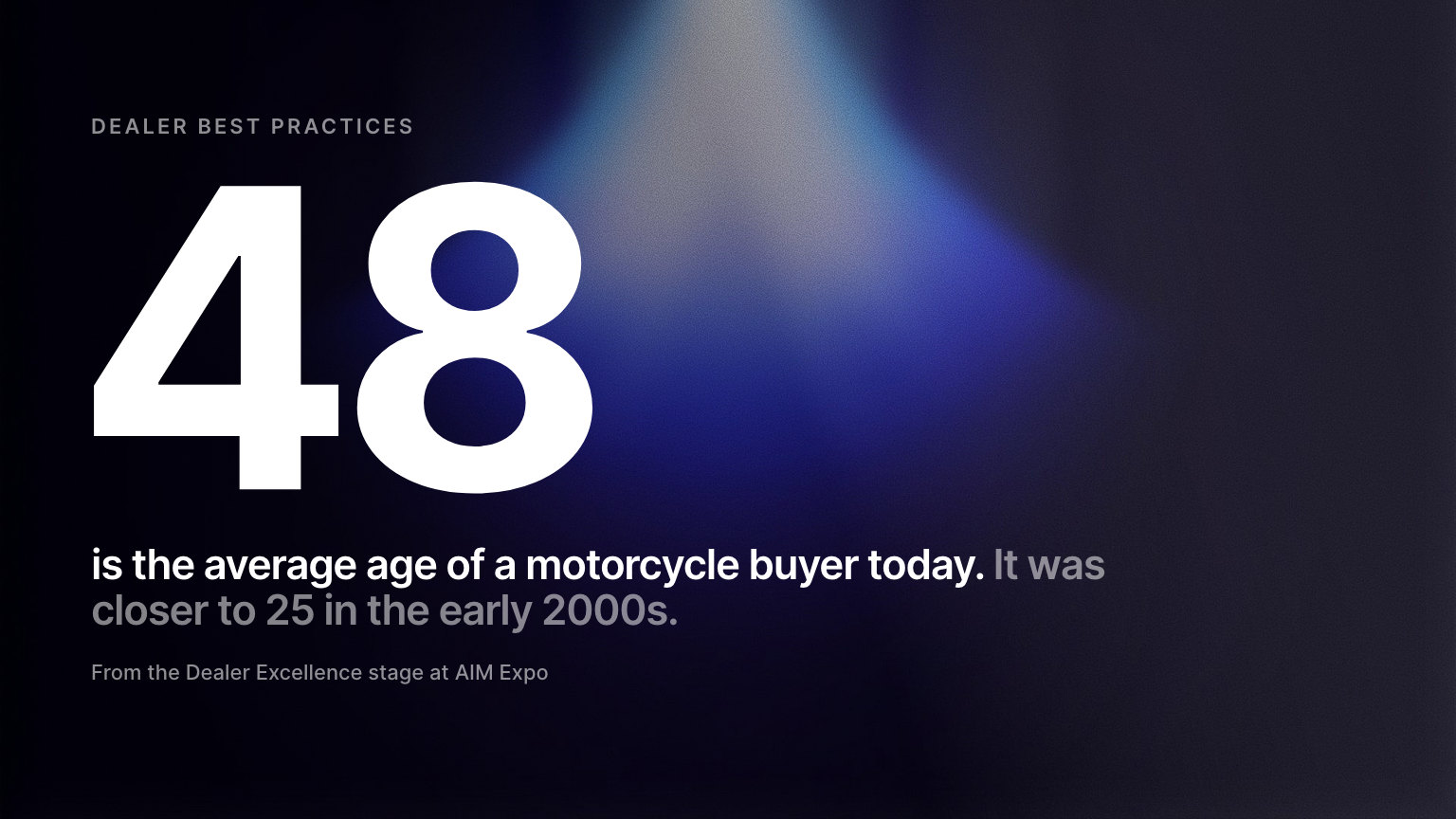
The average age of a motorcycle buyer today is 48. In the early 2000s, that number was closer to 25.
That shift matters. A 48-year-old buyer — or a 60-year-old buyer — only has a finite number of motorcycle purchases left in their lifetime. That's not cause for panic, but it is cause for urgency. If the industry doesn't find ways to attract younger buyers, the math gets difficult very quickly.
One of the most important things dealerships can do is make sure they're equipped to provide a buying experience that matches how younger people are used to buying everything else — including mortgages, apartments, and cars. I recently signed a new lease in New York. I visited the apartment once and completed everything else from my couch. That's the bar.
If a 20-something-year-old can buy a home online, they expect to be able to buy a motorcycle online too. And if they can't, they may not buy one at all.
What Ekho's data tells us about online buyers
We've now processed thousands of end-to-end online transactions at Ekho — from financing through title, registration, liability insurance, KYC, and document execution. That gives us a unique dataset on who's actually buying online and why.
I shared three data points on stage that I think are particularly telling:
- 40% of all online buyers through Ekho are first-time buyers of the vehicle type they purchased. These are people entering the market for the first time — exactly the demographic the industry needs to capture.
- 40% of online shoppers said they probably or definitely would not have purchased without the online option. This is the incrementality argument. These aren't buyers you're replacing from your showroom floor. These are buyers you would have lost entirely.
- 88% of all online buyers through Ekho are younger than the average motorcycle buyer age. The online channel skews younger — dramatically so. If you want to bring down that average age, this is how you do it.
Taken together, these numbers paint a clear picture: the online buying channel doesn't compete with your showroom. It expands your addressable market to buyers who wouldn't have come in anyway.
Don't fear the F&I margin question — reframe it
One of the most common objections I hear from dealers about online sales is: "If someone's buying online, my F&I manager doesn't get a chance to bring them into the box."
The concern is understandable. If pricing is transparent on your website and a buyer can check out without sitting across from your finance team, where does the backend margin come from? And what about negotiation — doesn't transparent pricing just encourage buyers to bounce if they don't see the number they want?
I addressed this head-on during the panel with two points.
First, the tooling exists. There are tools today — Ekho included — that use artificial intelligence to intelligently package F&I products for the online buyer in a way that continues to optimize backend margin. Just because the buyer isn't in a physical box doesn't mean the opportunity disappears. It just moves to a different format.
Second, and more importantly, optimize for lifetime value — not deal margin.
Even if you take a slight haircut on margin on an individual online sale, remember who you're selling to. These are predominantly younger, first-time buyers. A 20-something-year-old you close on a new motorcycle today has a lifetime value that can easily reach the hundreds of thousands of dollars — if they come back for their next unit, if they buy accessories, if they service with you, and if they bring their family when the time comes.
If your salespeople's incentive structures are optimized purely for per-deal margin, you're optimizing for the wrong thing. Optimize for lifetime value, and a slight margin concession on an online sale becomes one of the best investments you can make.
Differentiating beyond price
A question that came up during the panel was: if every dealer can sell like Carvana, do prices just race to the bottom?
The answer is no — and we can ground that in the fact that virtually every other physical commerce vertical already has these tools. Those businesses are doing fine. They find other ways to differentiate even when the underlying products are sometimes commoditized, as they often are with new unit sales.
Here are three areas I highlighted:
1. Fulfillment
Can you offer nationwide delivery? Not just the capability, but how quickly does it arrive? Is it going to be damaged? Does the buyer have to install things themselves? Fulfillment quality is a real differentiator and a muscle that gets stronger over time.
2. Fixed ops and follow-up
What are you doing after the sale? Follow-ups, check-ins, servicing — these are the touchpoints that build loyalty and drive repeat business. The sale is the beginning of the relationship, not the end.
3. Showing up first online
This is the one that's evolving the fastest. In the old world, we talked about Google SEO. In the new world, we're talking about generative engine optimization — how your dealership shows up in AI search when someone asks ChatGPT or a similar tool for help finding their next ride.
We recently found that around 30% of leads are now using AI search as part of their vehicle discovery process. That number is only going up. If your dealership isn't visible in AI-generated answers, you're invisible to a growing share of your future customers.
The post-purchase experience matters more than you think
E-commerce doesn't end with the buy button. I spent time on the panel talking about what happens after a buyer commits — the minutiae that stands between a deposit and legal ownership.
That includes:
- Titling and registration
- Liability insurance (depending on state and model)
- Identity verification
- Sales document execution
- Titling and registration documents — which may require a wet signature, an e-signature, or a notarized document depending on the jurisdiction
If you can automate all of that and tell a buyer upfront, "This is going to take you 20 minutes," you've created a fundamentally different experience than the alternative — which is often a FedEx packet, a request to come into the store, or a vague promise that "someone will be in touch."
We spent about 18 months at Ekho building out the compliance and licensure infrastructure to handle these workflows across all 50 states. It wasn't glamorous work, but it's the kind of thing that directly translates to conversion and buyer satisfaction. The post-purchase experience is where trust is either built or broken.
What to do when you get back to your dealership
I closed the panel with two concrete recommendations:
First, dip your toes into true end-to-end online sales. I've spoken to hundreds of dealers at this point, and until recently I hadn't met one that was truly offering a Carvana-like online buying experience for powersports. That's changing. There are now tools — structured so you only pay when online sales actually come through — that make it possible to experiment without disrupting your existing operations.
Second, audit your online visibility. Understand how your dealership performs in both traditional search and AI search relative to the 10 or 15 competitors within a 120-mile radius. At minimum, this gives you a benchmark. At best, it shows you exactly where to focus your digital investment.
The bottom line
The powersports industry doesn't have a demand problem — it has an accessibility problem. There are buyers out there who want what we sell. They're just not willing to buy it the way we've traditionally sold it.
Meeting those buyers on their terms isn't about abandoning the dealership experience. It's about expanding your reach to include the growing segment of customers who will never walk through your door — but who will happily click "Buy Now" from their couch.
The dealers who figure this out first will capture a disproportionate share of the next generation of riders. And that's a competitive advantage that compounds over time.
Frequently asked questions
The average age of a motorcycle buyer today is 48, up from around 25 in the early 2000s. An aging buyer base has a finite number of purchases remaining, which means the industry must find ways to attract younger buyers or face declining volume. Online purchasing is one of the most effective ways to reach this demographic.
No. Data shows that 40% of online buyers said they probably or definitely would not have purchased without the online option. These are incremental sales from buyers who would never have walked into a dealership. The online channel expands the addressable market rather than cannibalizing existing showroom traffic.
Approximately 40% of all online buyers are first-time buyers of the vehicle type they purchased, and 88% are younger than the average motorcycle buyer age. These are exactly the demographics the industry needs to capture for long-term growth, and the online channel is overwhelmingly how they prefer to buy.
Tools now exist that use artificial intelligence to intelligently package F&I products for the online buyer in a way that continues to optimize backend margin. More importantly, dealers should optimize for lifetime value rather than per-deal margin. A younger, first-time buyer closed online has a lifetime value that can easily reach hundreds of thousands of dollars in future units, accessories, and service.
Dealers can differentiate through fulfillment quality (speed, condition, and nationwide delivery), fixed operations and post-sale follow-up that builds loyalty, and online visibility including how they show up in AI-driven search results. Research shows that around 30% of leads now use AI search as part of their vehicle discovery process.
The post-purchase experience includes titling and registration, liability insurance verification, identity verification, sales document execution, and jurisdiction-specific signature requirements. Automating all of this and telling buyers upfront that it will take about 20 minutes creates a fundamentally different experience than the traditional approach of FedEx packets and vague follow-ups.