How to show out-the-door pricing on a dealer website
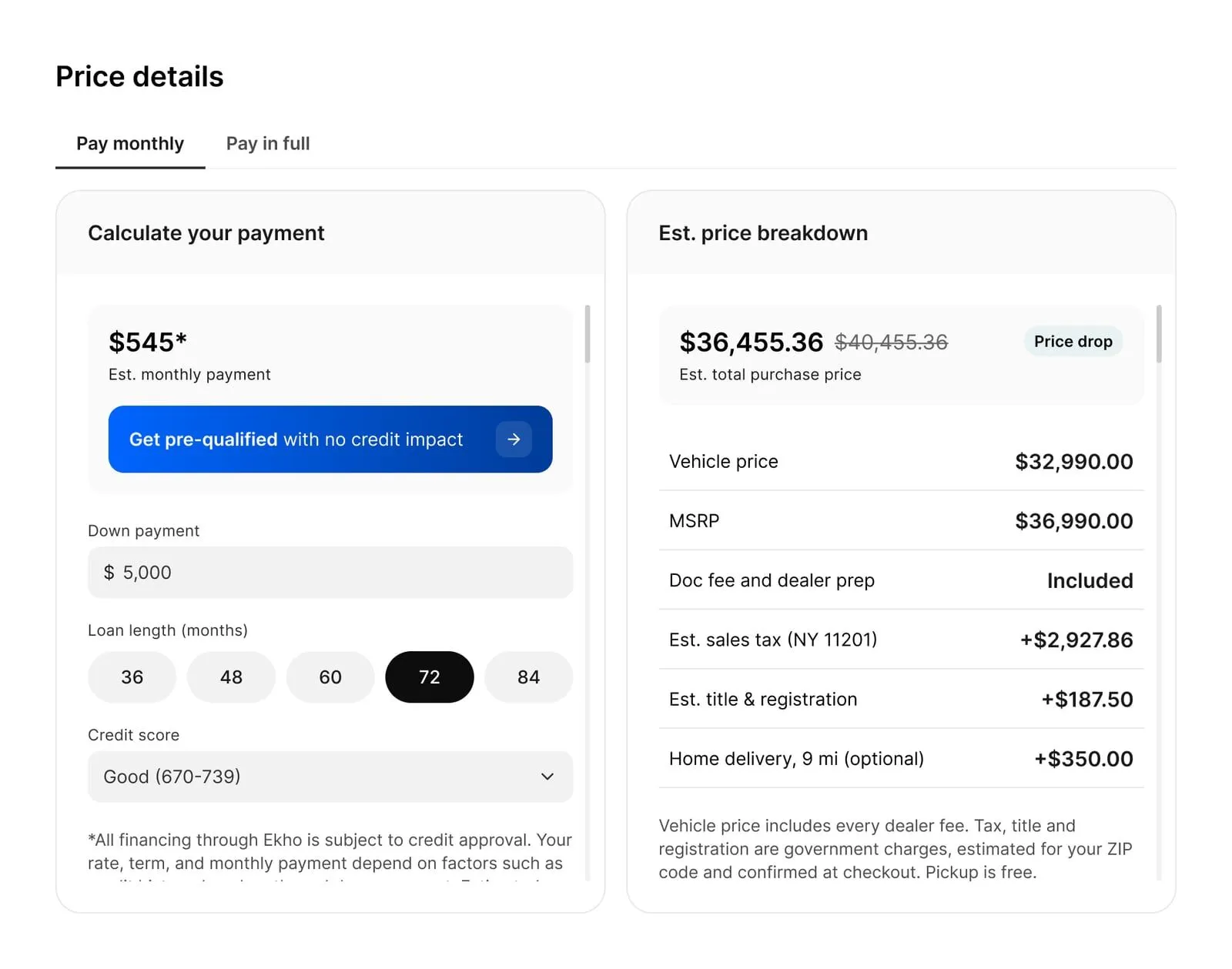
An out-the-door price is the number the buyer will actually pay: the unit, with every dealer fee already inside it, plus tax, title and registration, calculated for where they live.
The FTC’s September 2026 pricing transparency FAQs settled what the advertised number has to be: the price any consumer can walk in and pay, with only government charges left out. Showing the real one is a pricing-engine problem before it is a design problem, because the total has to be computed per buyer rather than typed once. We wrote about what the FAQs change in who owns the advertised price. This page is the how.
What goes into an out-the-door price
- Vehicle price
- The advertised price, and the number every dealer-required charge lives inside: doc fee, freight or destination, setup and PDI, reconditioning, any market adjustment. Kept in sync with your own site so the number a buyer sees is the number you are asking.
- Taxes
- A government charge, so it may sit outside the advertised price. Calculated against the buyer’s jurisdiction rather than the dealership’s, which is what makes an out-of-market quote either right or useless.
- Title and registration
- The state filing costs, itemized rather than folded into a single administrative line. Together with tax these are the only amounts the FTC lets a dealer leave out of the advertised number.
- Dealer fees
- Shown as their own lines so the buyer can see what the advertised price already includes. Fees that come to nothing are left off the order and its paperwork entirely, so the buyer is not reading zeroes.
- Coverage
- F&I and aftermarket products appear only when the buyer selects them, from one menu even when the dealership runs several coverage providers. Nothing is pre-checked and nothing is described as required.
- Promotions
- Dealer and manufacturer offers are priced into the deal rather than mentioned beside it, so the total already reflects everything the buyer qualifies for.
How to put it on your website
Eight moves, in the order a buyer meets them. The first two are the FTC’s standard. The rest are what makes the number hold from the vehicle page to the signed contract.
-
Put every dealer fee inside the advertised price
The FTC’s own example is a $40,000 vehicle with an $85 doc fee, advertised at $40,085. If a fee is mandatory, it is in the number. If it varies by buyer, the number carries the highest one. Say “freight and setup included” rather than “no fees,” which is a different claim.
-
Make the actual price the most prominent number
On search results and vehicle pages the price a buyer can pay has to be the largest and first amount the eye lands on. MSRP, a strike-through and a conditional discount can sit beside it, smaller, with their terms clear.
-
Calculate for the buyer, not for the store
An out-the-door number computed against your own jurisdiction is wrong for anyone outside it, and out-of-market shoppers are the ones most likely to ask. Tax, title and registration all key off where the buyer lives.
-
Itemize instead of aggregating
A single “fees and taxes” line reads as something to be negotiated later. A broken-out list reads as a total. Ekho’s vehicle page and checkout show the same breakdown for exactly this reason.
-
Drop the empty lines
A fee that comes to nothing does not build trust by appearing as a zero. It adds a row the buyer has to interpret. On Ekho, zero-dollar fee lines are left off the order and its paperwork.
-
Price the offers in
A promotion listed next to the price makes the buyer do arithmetic. A promotion applied to the price makes the number credible. On Ekho, every offer a buyer qualifies for is priced into their deal on the vehicle page and again at checkout.
-
Show financing as its own comparison
Cash out-the-door and financed out-the-door are different questions. On Ekho, each lender’s offer appears as its own card with a price and payment breakdown, so a buyer compares real offers rather than one illustrative figure.
-
Put it where the shopper already is
The number belongs on the vehicle page, in the conversation and in the checkout, not behind a form. A price a buyer has to request is a price they will go and find somewhere else.
The regulation, and the system behind the number
- Who owns the advertised price? The FTC just answered What the September 2026 FAQs say, who they hold responsible, and what to do before the end of the month.
- The end of the price-on-the-windshield era Where dealers get exposed under total-price enforcement, and why the same patterns extend across every titled-vehicle segment.
- See how the Transaction Engine prices a deal One price and one fee schedule from the vehicle page to the signed contract, in all 50 states.
Questions dealers ask
The total a buyer will actually pay to take the vehicle home: the advertised price of the unit, which already includes every dealer fee, plus sales tax, title and registration, less any promotion they qualify for. If a number is missing from it, it is not an out-the-door price.
The FTC’s September 2026 pricing transparency FAQs say the advertised price must be the actual price any consumer can walk in and pay. Every dealer-required charge is inside it, including the doc fee, freight or destination, setup, PDI and reconditioning. Only charges a government requires the consumer to pay, such as sales tax, title, registration and license, may be left out. The standard applies to websites, search results, vehicle pages, social, print, signs, phone calls and text messages, and the FAQs say there is no grace period.
Everyone who has control over the advertising. The FAQs say dealers must give the actual price to third parties and take the steps within their control to have it shown most prominently, third-party advertisers must display it that way, and manufacturers should make sure none of their policies or practices conflict with the requirement.
The buyer’s home state sets the tax basis, not yours. Ekho computes tax, titling and registration against the buyer’s jurisdiction across all 50 states and the District of Columbia, so an out-of-market quote is accurate without your desk looking anything up.
The comparison a shopper is making is not between your out-the-door price and your advertised price. It is between your out-the-door price and the one they can get elsewhere in a few seconds. A buyer who has to ask what a unit really costs has already been given a reason to ask somewhere else, and the major listing sites now badge or rank listings by whether fees are disclosed.
Yes. The FAQs are addressed to automobile dealers, but they rest on Section 5 of the FTC Act, which applies to anyone advertising a price. The same disclosure patterns extend across every titled-vehicle segment, and Ekho processes tax, titling and registration for every titled vehicle type it supports, including off-road classifications.
Ekho calculates the out-the-door price itself at checkout, itemized for the buyer’s jurisdiction with every offer they qualify for priced in. When a shopper asks for a price in the conversation, Ekho’s AI Sales Agent asks your team for that single figure as an action item, then writes the reply to the buyer and keeps the conversation going, and where you enable it, it can guide the buyer straight into checkout to see the full total.