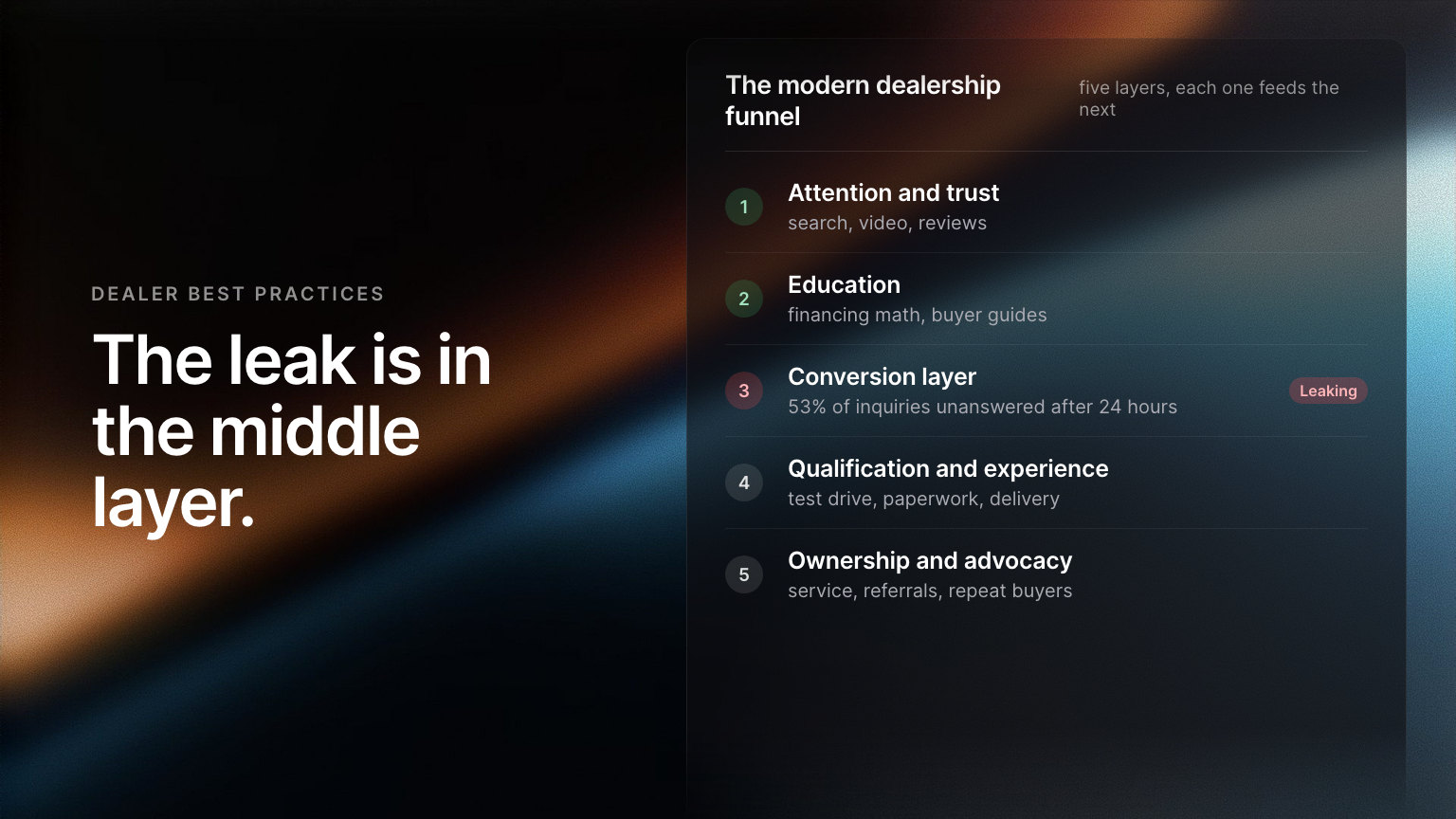
Most dealerships still run a funnel built for buyers who needed the showroom to get answers. Today’s buyer arrives with the research done, and most deals are now won or lost in the conversion layer, between the lead form and the first real reply.
Most dealer principals and general managers learned the same playbook. The store holds the information, so the salesperson holds the leverage. You do not quote price over the phone. You do not email the out-the-door number. You do not answer the financing question until the buyer sits down. You get them in the door and you close in person.
That playbook made sense when a buyer could not compare three stores in one evening. The showroom was the only place to get a real answer, and the answer was the leverage. Buyers now get most of those answers before they contact you, but many floor processes still run as if they cannot.
The buyer did the homework before the form
By the time a buyer fills out the form on your site, most of the research is done. GE Capital’s Major Purchase Shopper Study found that 81% of buyers research online before they buy. Cycle Trader’s buyer research puts about half of powersports buyers in contact with four or more dealerships before they decide. A survey of 2,690 drivers for Quantrell Subaru found that buyers would travel an average of 469 miles for the right vehicle.
That buyer has watched the reviews, read the forum threads, and had your inventory page open next to two of your competitors’. What they still need from you is a fast answer, a process that respects their time, and someone who acts like an advisor. A store that holds back the price and pushes for the appointment gives them none of those.
What the old funnel costs, in dollars
Put a number on it before you change anything. Take a single-store dealership that buys 1,000 web leads a month across search, social, and listing sites, at about $40 a lead. Your numbers will differ, and the math works the same at 300 leads or 3,000.
Pied Piper mystery-shops thousands of dealerships every year across motorcycle, powersports, RV, marine, and auto. Its 2026 study found that 53% of inquiries got no response within 24 hours. Its 2024 study of 3,718 dealers found that 30% of leads never got a response at all.
If half of that store’s leads wait more than a day for a reply, about $20,000 of the month’s lead spend goes to buyers who moved on before anyone talked to them. That figure counts only the spend. It leaves out the sales those conversations would have produced, which vary too much by segment for one number. The spend is in your ad accounts, and you can check it tonight.
The modern funnel has five layers
The old funnel had three stages: lead, appointment, sale. A more useful model for today’s buyer has five layers, and each one depends on the one before it:
- Attention and trust
- Education
- The conversion layer: response time, after-hours coverage, lead capture, and the trust signals a buyer sees at the moment of decision
- Qualification and the buying experience
- Ownership and advocacy
Many dealers spend heavily on the first two layers and very little on the third. The third layer is where a buyer’s interest turns into a conversation with your team, so a weak third layer wastes the money spent on the first two.
Layer 1: Earn attention and trust
Attention comes from the channel mix most dealers already run: organic search, YouTube, Maps, short video, paid social and search, local events, group rides, and cars-and-coffee meets. What makes it work is a hook that names a real buyer problem. “Best price in town” does not do that. “Why your trade is worth more in March than in May” does.
Trust is harder, and many stores lose buyers here before the funnel even starts. Buyers trust a dealership that shows real prices, answers reviews quickly, puts names and faces on its staff page, publishes on a regular schedule, and does not hide fees on the inventory page. People still buy from people they trust. Today they make that call on your website, before they meet anyone.
The free Ekho Website Grader scores how your site shows up in search and in AI answers, in a few minutes. It is a quick way to see your store the way a buyer finds it.
Layer 2: Teach before you sell
A buyer who trusts the store wants guidance next. Confused buyers stall, and dealerships create more confusion than they think.
Education that sells looks like a financing page with real math on it, ownership guides for each segment (a first UTV, a first travel trailer, charging a first EV at home, the street-legal rules for a golf cart), and comparisons that admit the trade-offs. A buyer in Phoenix who asks whether a golf cart can go on the road deserves the same care as a buyer in Charlotte who asks how RV financing works.
Give away the what and the why. A buyer who reads three of your guides arrives with most of the decision made. They need a salesperson who can confirm it, and paperwork that does not drag.
Community events belong in this layer too. Bike nights, owner clinics, and ride days build loyalty once buyers trust the store. Before that point, they mostly spend the event budget.
Layer 3: The conversion layer
The conversion layer is everything between a buyer raising a hand and a person on your team talking to them. SEO lead generation brings the traffic, and this layer decides how much of that traffic becomes a conversation. It has four parts, and you can fix each one in days.
Response time
The research on response speed is old and consistent. A lead contacted within five minutes is 21 times more likely to qualify than one contacted after thirty minutes, and the average company in that research took 42 hours to respond. Lead Connect found that 78% of buyers purchase from the first company that responds.
Buyer interest fades fastest in the first hour. A reply four hours later often reaches someone who already booked a test drive somewhere else. Pied Piper’s 2026 study found that dealers who respond fast sell about 50% more than the industry average. At the same lead volume and ad spend, that can be the difference between a 12-sale month and an 18-sale month.
After-hours coverage
A VisQuanta study of 7,041 dealer leads found that 53% arrived outside weekday business hours. NADA puts more than 60% of buyer browsing after 5 p.m.
So a store with a five-minute response policy from 8 a.m. to 7 p.m. still misses about half of its leads, because they come in at 9:47 on a Tuesday night. A buyer who fills out forms on three dealer sites that night will often buy from the one that answers first.
Asking the BDC to work until midnight does not scale. What works is a conversation that runs around the clock: it answers, qualifies, and books after-hours leads the way the day shift would, then hands each one to a person with the context attached. The Ekho AI Sales Agent does this over web chat and text. For more on the gap itself, read why your best buyers don’t keep business hours.
Lead capture
Each extra form field costs you leads. So does each required dropdown, and each “we will get back to you within one business day” auto-reply. The fewer steps between a question and a conversation, the more conversations you get.
The dealers who improve most cut their forms to two or three fields, replace the auto-reply with an immediate conversation, and answer an after-hours lead the same night. A site that answers the question on the vehicle page, where the buyer asks it, does better than one that sends every question to a single contact form. That is the idea behind the Ekho AI Website, which is open for waitlist sign-ups.
Trust signals at the moment of decision
A buyer in this layer is in the middle of a decision, and what they see at that point matters: clear pricing, real staff photos, review counts, a stated response time, and a real answer to “what is my trade worth?” A fast reply from a site full of stock photos and a contact form that goes nowhere can still lose to a slower store that looks trustworthy.
If you fix one layer this quarter, fix this one. The first two layers deliver buyers to it, and the last two depend on it.
Layer 4: Qualify and deliver the experience
Qualification used to happen on the sales floor: budget, trade, financing, timeline. Now it starts on your website. Which pages a buyer comes back to, how long they spend on the financing page, whether they valued a trade, and whether they opened a chat at 11 p.m. all tell you how close they are to buying.
The buying experience is where the store proves what the earlier layers promised: a showroom that matches the website, staff who know the product, a clear delivery process, fast paperwork, and plain disclosures. Picture a buyer in Austin who watched three of your videos, got a reply at 10:14 p.m., talked to a salesperson who confirmed what they had already decided, and signed in 35 minutes. That buyer is the one most likely to send you the next three.
The Ekho Transaction Engine handles the paperwork side: checkout, financing, titling, registration, and tax across all 50 states, so a deal the conversation started can close online without adding work for your staff.
None of this helps if the third layer failed. A well-qualified buyer who waited 36 hours for a reply has usually bought somewhere else.
Layer 5: Run ownership like a funnel stage
The funnel continues after delivery. Service, accessories, owner events, second purchases, and referrals all come after the sale, and over a few years they usually earn more than it cost to win the buyer.
The dealers who do this well run ownership with the same discipline as sales. They schedule service reminders. They release accessories on a set calendar. They invite owners to events. They ask for feedback after the first service visit and act on it. They make a referral the easiest thing to do in the post-purchase emails. Take an RV dealer who texts every owner a month before camping season with a service slot held, two accessory ideas, and an invitation to an owner rally. That text is layer five in practice.
Owners who feel looked after leave reviews, refer friends, and come back, and that is where advocacy comes from.
Where AI does real work in the funnel
Dealer media is full of AI talk. Inside the funnel, AI does useful work in three places today:
- Lead conversation. An AI sales agent answers in the first minute, qualifies in plain conversation, books appointments, and hands off to your team with the context attached.
- The website. A site that answers questions on the page, instead of sending them to a form, catches intent while the buyer still has it.
- The transaction. Titling, registration, tax, and financing paperwork across 50 states used to need extra staff, or meant turning out-of-state buyers away.
The split that works: AI takes the repetitive, after-hours, and high-volume work, and your people take the conversations that need judgement and a relationship.
A scoreboard for the new funnel
Most dealership scoreboards still lead with top-of-funnel numbers, which is why a weak conversion layer goes unnoticed. A five-layer funnel needs a different order:
- Attention, kept but moved down: reach, branded search volume, organic traffic, and Google Business Profile views.
- Trust: review response time, review growth, time on the financing page, and staff-page visits.
- The conversion layer, moved to the top: median first-response time, after-hours first-response rate, lead-to-appointment rate, no-show rate, and the share of leads that never got a reply.
- Experience: lead-to-delivery time, post-delivery satisfaction, and delivery-day complaints.
- Advocacy: referrals, second purchases, and repeat event attendance.
If you track only five numbers a month, take them from the conversion-layer row.
Fix one layer this week
You do not have to rebuild all five layers at once. Find the weakest one and fix it first. For most stores, that is the conversion layer.
Start with numbers you already have: how many leads came in last month, what you paid for them, and how many got a real reply within five minutes, day and night. If the answer to the last question is “fewer than half,” that is where the $20,000 goes. Book a demo to see how Ekho answers web chat and text leads in seconds, at any hour.
Frequently asked questions
It is a five-layer model of how today’s buyer moves from first contact to repeat customer: attention and trust, education, the conversion layer, qualification and the buying experience, and ownership and advocacy. The main change from the older lead-appointment-sale funnel is that buyers arrive with their research done, so most deals are won or lost in the conversion layer, between the lead and the first real conversation.
It was built for a buyer who needed the showroom to get answers, so the salesperson held the leverage by holding back price and financing details. Today about 81% of buyers research online before they buy, and about half of powersports buyers contact four or more dealers. A process that withholds information and pushes for the appointment works against how these buyers decide.
Buyer interest fades fastest in the first hour. Research published in Harvard Business Review found that a lead contacted within five minutes is 21 times more likely to qualify than one contacted after thirty minutes, and Lead Connect found that 78% of buyers purchase from the first company that responds. Pied Piper’s 2026 study found that fast-responding dealers sell about 50% more than the industry average.
Take a store that buys 1,000 web leads a month at about $40 each. Pied Piper found that 53% of dealer inquiries get no response within 24 hours. If half of that store’s leads wait more than a day, about $20,000 a month in lead spend goes to buyers who moved on before anyone talked to them, before you count the lost sales.
The conversion layer is everything between a buyer raising a hand and a person on your team talking to them: response time, after-hours coverage, how the site captures a lead, and the trust signals a buyer sees at the moment of decision. It is the most fixable part of the funnel, and the place where most dealers lose the buyers their marketing already paid for.