
Carvana spent $160M acquiring franchise dealerships and turned one into the top-selling CDJR dealer in America. You can’t compete on price or inventory. Here are the three battlegrounds that matter.
Joshua Higginbotham wanted a new Jeep Wrangler. He did not want the experience that comes with buying one.
So the 43-year-old dad near Kansas City pulled up his laptop, found the $51,000 Wrangler he wanted at a dealership in Casa Grande, Arizona, more than 1,000 miles away, and ordered it. No showroom. No trade-in lowball. No four-hour Saturday. He paid $1,290 for shipping and skipped the negotiation entirely (WSJ, May 2026).
That dealership in Casa Grande? It used to sell 30 to 50 vehicles a month. Under its new owner, it moved 350 in April and became the top-selling Chrysler, Jeep, Ram, and Dodge dealer in the country (Entrepreneur).
The new owner is Carvana.
The $655 Billion Wake-Up Call
For years, Carvana was a used-car story. A vending-machine gimmick that nearly went bankrupt in 2022. Easy to dismiss.
That dismissal just got expensive. Carvana has spent over $160 million acquiring seven Stellantis franchise dealerships in the past year. It posted $6.4 billion in Q1 2026 revenue, up 52% year over year. Its market cap sits north of $75 billion. And it is now pointed squarely at the $655 billion new-car market.
This is not a pilot. Carvana controls reconditioning (through its ADESA network), financing (in-house), logistics (nationwide delivery fleet), and now, franchise retail. It is one of the most vertically integrated vehicle retailers on the planet, and it is coming for your customers.
Stellantis dealers are already feeling it. At a closed-door meeting in February, tensions over Carvana’s expansion brought the conversation to an abrupt halt. Stellantis has since imposed a rule limiting dealers to one acquisition per year. One South Florida Jeep-Ram dealer put it plainly: “Stellantis dealers are in an uproar over this” (WSJ).
And Stellantis is just the beginning. If this model works, and the Casa Grande numbers say it already does, other OEMs will follow.
Why You Can’t Win on Price or Inventory
Here is the uncomfortable math.
Inventory is commoditized. A new Jeep Wrangler at your store is the same Jeep Wrangler at the store 200 miles away. There is no product differentiation. The unit is identical. The only question is who makes it easier to buy.
Price is a losing game. Carvana is vertically integrated from acquisition through financing through delivery. It can absorb razor-thin margins on new units because it monetizes across the entire ownership lifecycle: financing, insurance, service contracts, reconditioning, resale. You are competing against a company willing to break even on the front end to own the customer relationship.
And even if you wanted to undercut them, OEM MAP policies limit how aggressively you can advertise below MSRP outside your PMA. Meanwhile, Carvana lists the final price online, transparently, before the customer ever picks up the phone.
This is not a coincidence. The FTC warned 97 auto dealer groups in March 2026 about deceptive pricing practices (FTC Press Release, Mar 2026). The $20 million Asbury Automotive settlement, the largest in FTC history for a dealer group, sent the same message (Mayer Brown, 2024). The regulatory environment is moving toward the kind of transparent, total-price-upfront model that Carvana already operates. For more on what this shift means for your store, read our deep dive on transparent pricing and the future of vehicle retail and the end of the price-on-the-windshield era.
If you cannot win on inventory and you cannot win on price, what is left?
Three things.
Battleground 1: Purchase Experience
The new benchmark for purchase experience is no longer the dealer down the road. It is a company that lets a buyer in Kansas City order a $51,000 vehicle from Arizona while sitting on the couch.
To compete, you need infrastructure that turns your dealership into a nationwide retailer, one where a buyer can go from browsing to financed, insured, signed, and scheduled for delivery in minutes, not days.
That is extraordinarily hard to do on your own. Here is what it actually requires:
- 50-state compliance. Titling, registration, and tax calculation vary by state, county, and municipality. Selling to a buyer in a different state means navigating a patchwork of DMV rules, tax rates, and documentation requirements.
- Lender integrations. You need financing options that work for out-of-state buyers, with lender waterfalls that route applications to the right program automatically. Not one phone call at a time. (See our breakdown of how online financing actually works.)
- F&I product packaging. Aftermarket products, GAP, and extended service contracts need to be automatically bundled based on lender advance and deal structure. The menu has to present itself to the buyer without an F&I manager on a phone call.
- Document execution and fraud detection. Remote transactions require identity verification, fraud screening, and legally binding signature collection across all 50 states: e-signatures, wet signatures, notarization, and power of attorney, each with different state-by-state requirements.
- Insurance verification. You cannot deliver a vehicle without confirming the buyer has coverage, and that coverage meets the lender’s requirements.
- Shipping logistics. Buyers expect delivery. That means partnerships with nationwide carriers, transparent shipping quotes, and tracking.
This is the infrastructure layer that separates “we sell online” from actually selling online. Most dealers who claim to offer digital retailing are really offering a lead form with a “Buy Now” button that hands the deal back to the F&I office. We wrote about why online vehicle sales usually breaks at checkout, and the six places where most solutions quietly give up.
How Ekho solves this
Ekho’s Transaction Engine handles the entire purchase flow: financing with automated lender waterfalls, F&I product menus that package based on lender advance, titling and registration in all 50 states, insurance verification, document execution (e-signatures, wet signatures, notarization, power of attorney), fraud detection, and shipping with exclusive nationwide carrier rates. Dealers and dealer groups plug it into their existing website and become a compliant, nationwide retailer. No custom integrations. No six-month build. The infrastructure that took Carvana billions to build, available to your store.
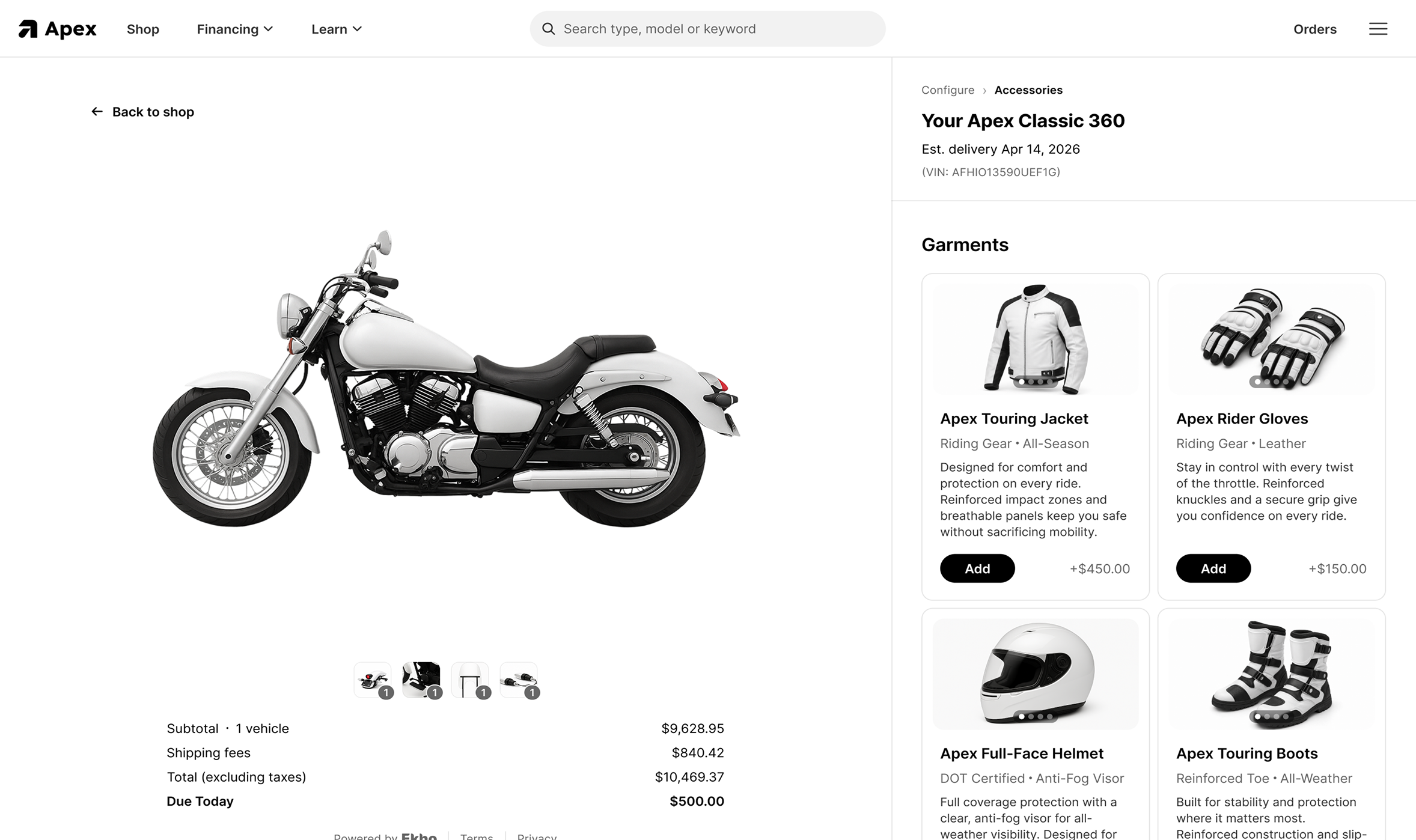
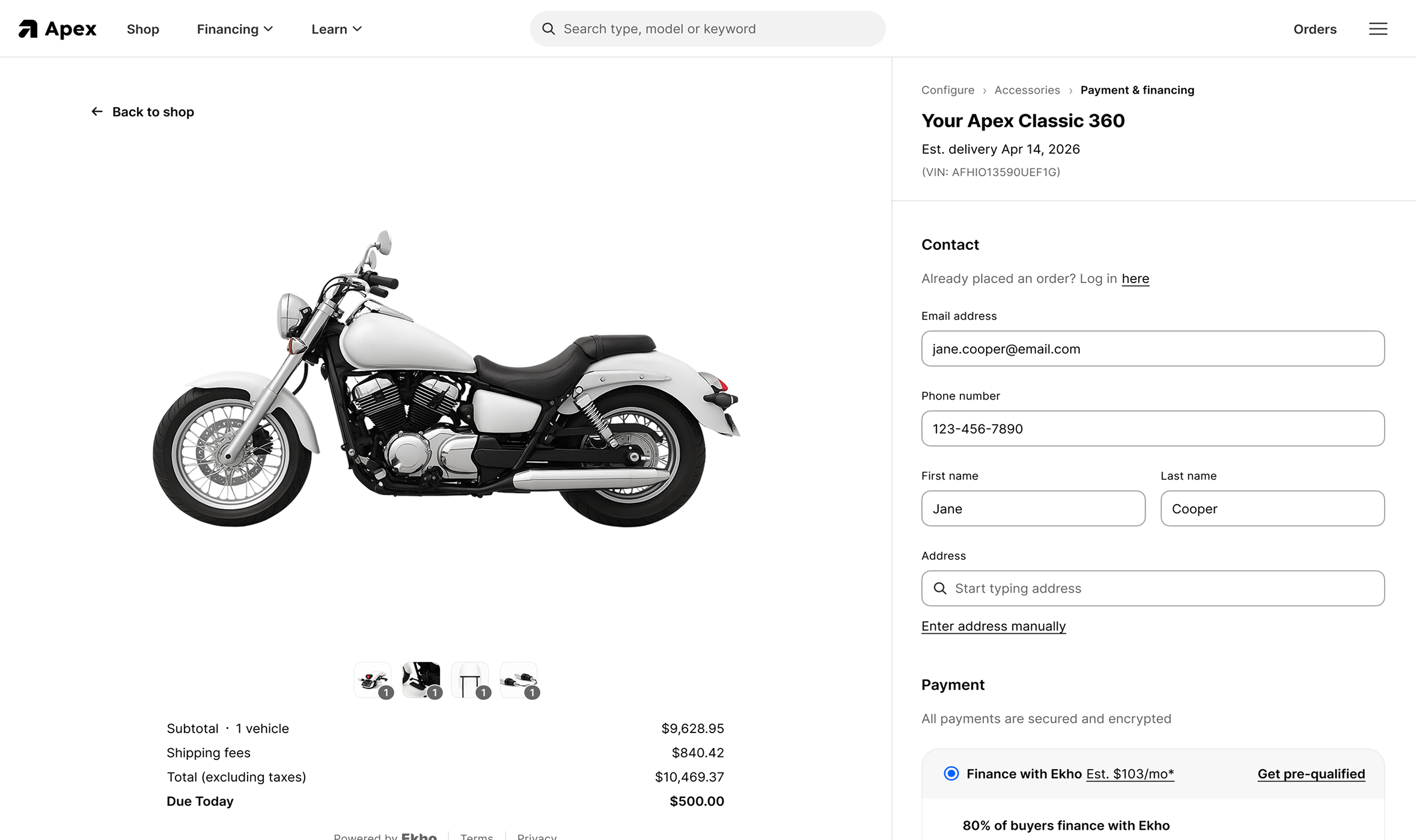
The buyer configures their vehicle, selects accessories, and sees the full order summary with shipping, taxes, and today's deposit in one view:
From there, they enter contact and payment information, get pre-qualified for financing in seconds, and lock in their deal:
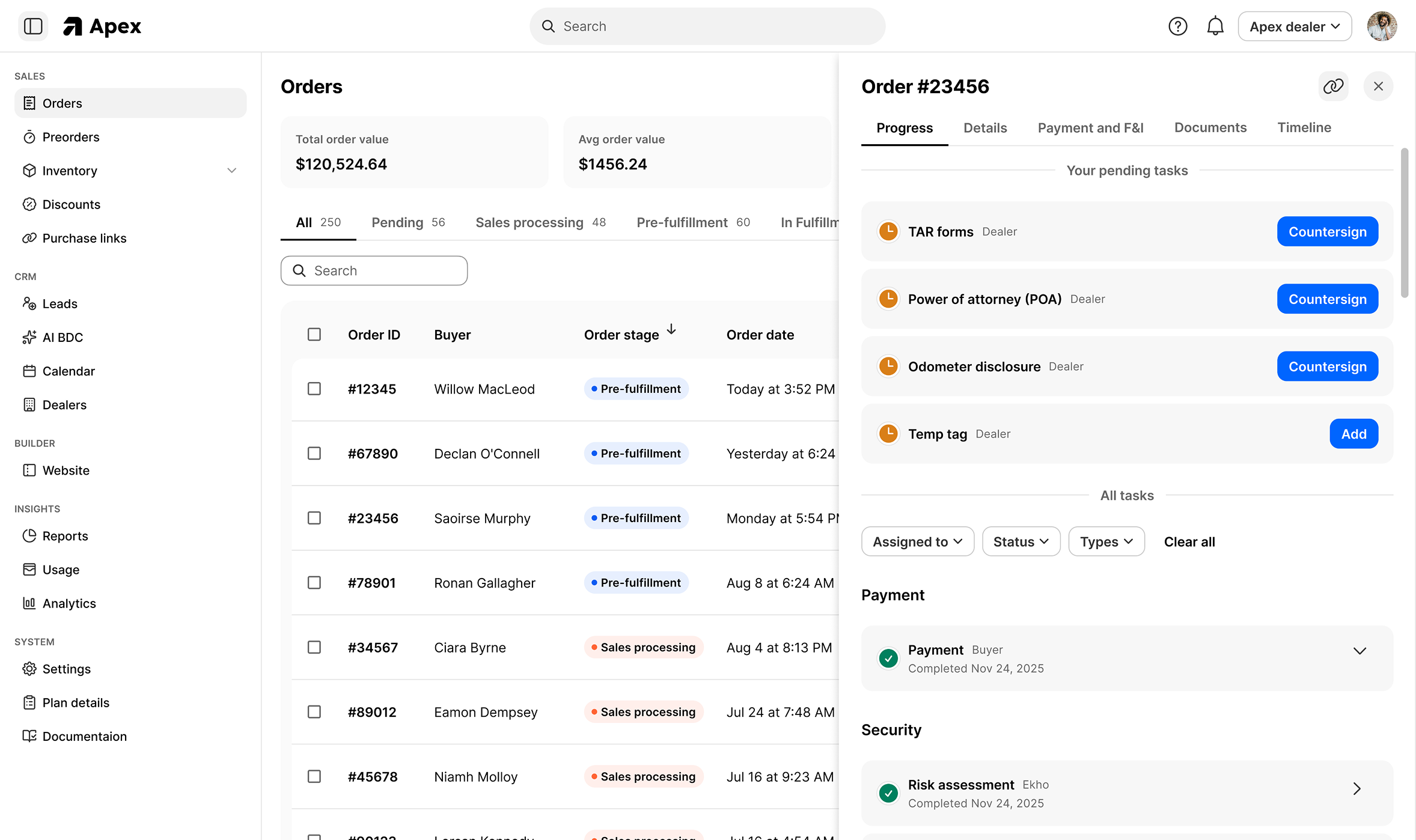
On the dealer side, every order flows into a single dashboard where your team tracks T&R forms, power of attorney, odometer disclosures, countersignatures, payments, and fraud checks, all in one place:
Battleground 2: Online Visibility
Carvana spends aggressively on customer acquisition. In traditional search, they will show up for “buy new Jeep Wrangler online” and every variant of it. They have the budget and the domain authority to dominate paid and organic search for new vehicle terms alongside the used-car terms they already own.
You cannot outspend them in Google Ads. But there is a window that is still open.
Thirty percent of in-market vehicle buyers now use AI search tools (ChatGPT, Perplexity, Gemini) to research purchases (Ekho internal, 2026). In AI search, the rules are fundamentally different. Visibility is not determined by backlink count or ad spend. It is determined by whether an AI model trusts your content enough to cite it. Trust signals come from structured data, original expertise, and content quality, not decades-old SEO moats.
We have written extensively about this shift. Start with why AI search is fundamentally different from SEO, then read our research on how vehicle discovery is shifting from Google to ChatGPT, and our technical breakdown of SEO vs GEO for dealership marketers.
How Ekho solves this
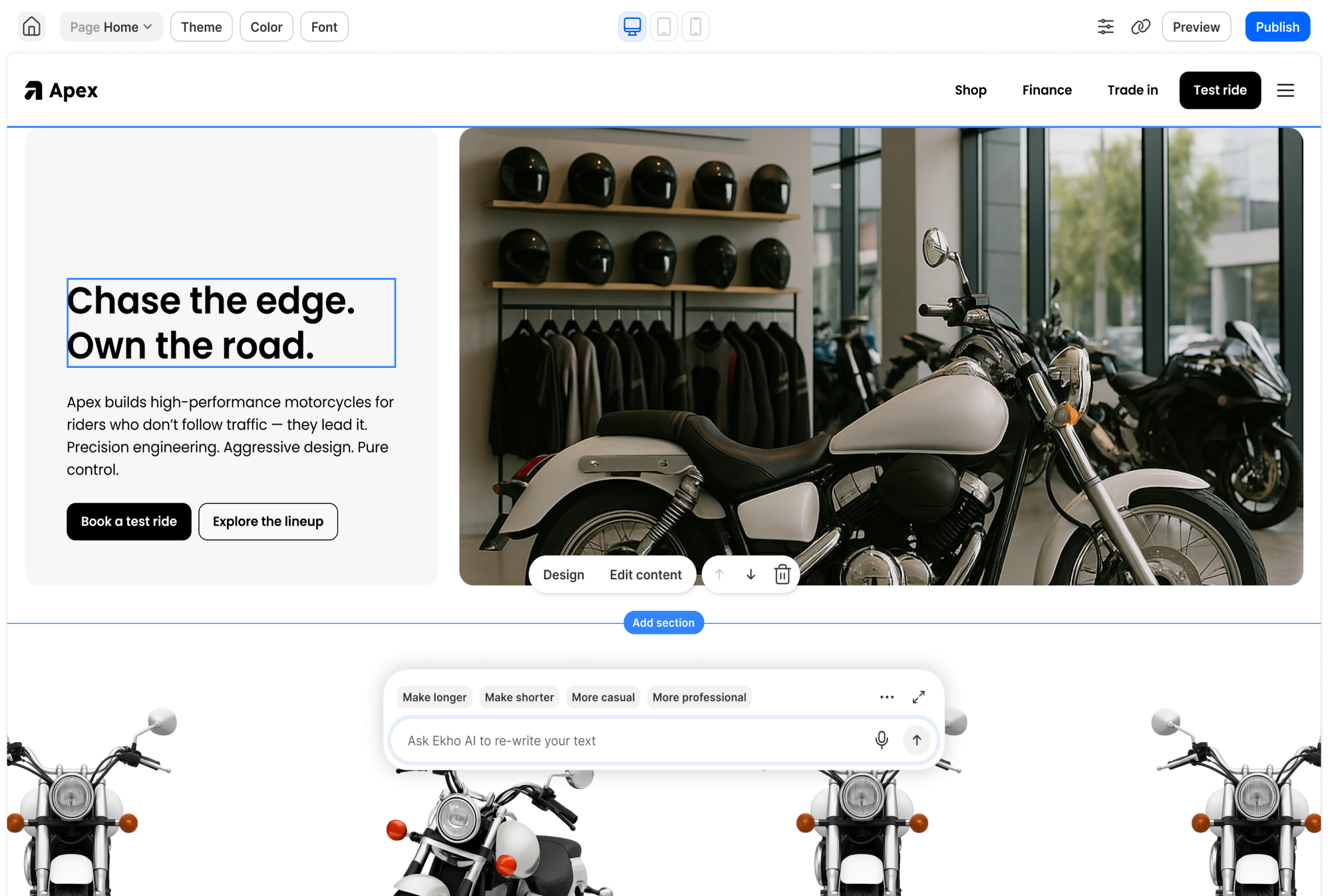
Ekho’s AI-native website infrastructure is built from the ground up for search visibility in both traditional and AI search engines. Structured data, schema markup, and content architecture designed to earn citations, not just clicks.
Try it yourself: run your dealership website through the Ekho Website Grader to see how you stack up.
Battleground 3: Speed to Response
Here is the detail that should keep you up at night: on Carvana’s site, the final price is right there. The buyer does not need to submit a lead form, wait for a callback, and hope someone at the dealership responds before they lose interest.
They just buy it.
Meanwhile, 53% of dealer inquiries get no response within 24 hours (Pied Piper PSI-ILE, 2026). The average dealer response time is 42 hours (MIT/Harvard Business Review). And 78% of buyers purchase from the first dealer that responds (Lead Connect Study).
Your best buyers are browsing at 11 PM on a Tuesday, and your sales floor is empty. Over 53% of leads arrive after hours (VisQuanta, 2026). We covered this in your best buyers do not keep business hours.
How Ekho solves this
Ekho’s AI Sales Agent responds to every lead instantly, 24/7, across your website, SMS, and email. It knows your live inventory, handles trade-in valuations, pre-qualifies buyers for financing, and books appointments. When a buyer is ready to purchase on the spot, the agent can walk them through the entire checkout, right there in the conversation. No waiting. No callback. The deal happens when the buyer is ready, not when your floor is open.
This is not a chatbot. It is a trained sales agent that understands your inventory, your financing programs, and your dealership’s voice. Read more in do AI sales agents actually pay off.
The Bottom Line
Carvana’s move into new-car sales is not an experiment. It is a $160 million bet backed by $6.4 billion in quarterly revenue and a vertically integrated machine that controls every step of the transaction.
You are not going to out-Carvana Carvana. But you do not have to.
The dealers who will thrive are the ones who stop competing on the terms Carvana sets (price, inventory breadth, marketing spend) and start competing on the terms they can win: local trust, expert knowledge, the relationships OEMs depend on, and infrastructure that gives buyers the experience they now expect.
That infrastructure exists today. If your store can sell a vehicle online, compliantly, to a buyer in any state, respond to leads in seconds instead of hours, and show up where buyers are actually searching, you are not just surviving the Carvana era. You are earning the customers they cannot reach.
Frequently asked questions
Yes. Carvana has acquired seven Stellantis franchise dealerships, spending over $160 million. Its Casa Grande, Arizona location became the top-selling CDJR dealer in the country, moving 350 units per month.
OEM MAP (Minimum Advertised Price) policies limit how aggressively any dealer, including Carvana, can advertise below MSRP outside their PMA. But Carvana's vertical integration means they can operate on thinner margins than most franchise dealers while still being profitable.
Stellantis is currently the only OEM that has allowed it. But if the model continues producing results like the Casa Grande numbers, other manufacturers will face pressure to follow.
Not on price or inventory. Dealers compete on purchase experience (making online buying frictionless), online visibility (especially in AI search), and speed to response (instant lead engagement). Infrastructure partners like Ekho provide the technology layer that makes this possible without building it yourself.
The FTC's March 2026 warning to 97 dealer groups signals a regulatory push toward transparent, total-price disclosure. Carvana already operates this way. Dealers who adopt transparent pricing proactively are better positioned both for regulatory compliance and for competing with digital-first retailers.