
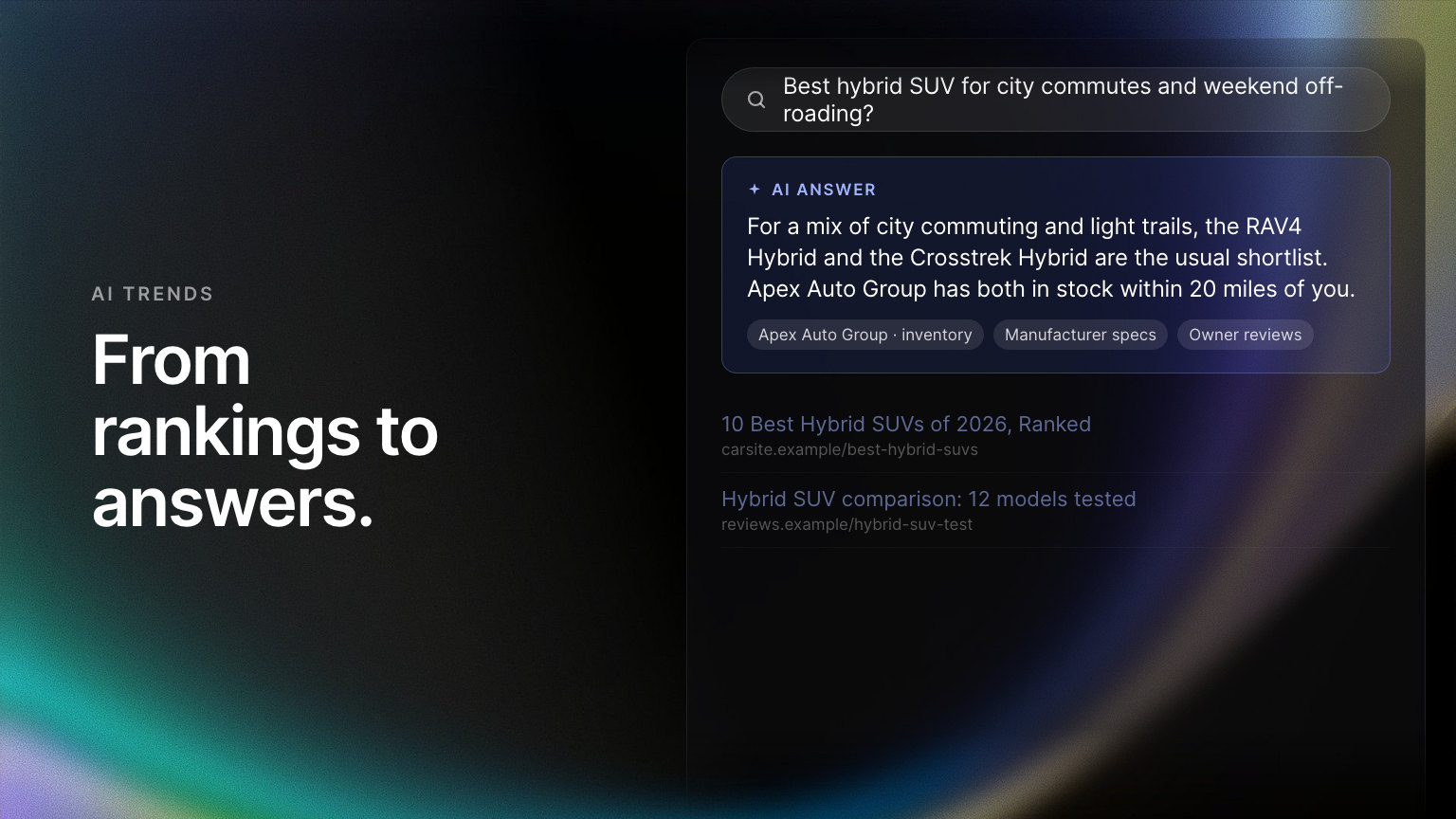
Vehicle discovery is quietly shifting from traditional search engines to AI tools like ChatGPT, where shoppers ask conversational, high-intent questions and often receive answers without clicking through to websites. As AI-driven discovery grows, dealerships must evolve from chasing rankings to becoming trusted answers. By producing authoritative, structured, and AI-friendly content, dealers can stay visible and influential throughout the modern vehicle buyer’s journey.
Key Takeaways
- AI is reshaping the discovery phase of vehicle shopping. More buyers now start research in ChatGPT and other AI tools before visiting websites.
- AI-assisted search is scaling rapidly. Generative AI is growing far faster than traditional search and is on track to influence most search behavior within a few years.
- Discovery and conversion are becoming distinct moments. AI helps shoppers narrow choices, but buyers still need a trusted destination to evaluate inventory and transact.
- AI-driven traffic is highly qualified. When shoppers do click through from AI-assisted discovery, they are significantly more likely to convert.
- Dealers must win both stages of the journey. Visibility in AI answers builds intent; a strong vehicle detail and checkout experience captures it.
- Content now fuels commerce. Authoritative, structured answers influence AI recommendations and guide shoppers toward purchase-ready decisions.
- Traditional SEO still matters — but it’s no longer enough on its own. Dealers need to optimize for AI discovery and downstream conversion.
- The competitive advantage lies in being discoverable and actionable. Dealers who pair AI visibility with a modern transaction layer will outperform those who rely on traffic alone.
A Quiet Transformation in Search Behavior
Most people still think of search as synonymous with Google, but real users are quietly shifting their habits. When they need clear answers fast – whether it’s which SUV fits a growing family, what ATV is best for trail riding, or how to choose a reliable pontoon boat – many now open ChatGPT instead of a search engine. This isn’t just a tech fad; it’s a measurable change in consumer behavior. By late 2025, over a third of U.S. adults had used ChatGPT (58% among those under 30) and about 60% of AI users say they use it to search for information. In fact, approximately 80% of all AI-based searches now occur through OpenAI’s ChatGPT, making it the first tool millions turn to for everyday questions.
This shift in discovery spans all types of vehicles and equipment. A few years ago, a prospective buyer might have typed “best compact SUV for city driving” into Google and sifted through links. Today that same shopper might ask ChatGPT, “What’s the best hybrid SUV for city commutes and weekend off-roading?” and get a conversational answer. Similarly, someone researching motorcycles could ask, “What’s a good beginner sport bike under $5,000?” or an outdoor enthusiast might query, “Which side-by-side handles both farm work and trail fun?” The marine buyer might wonder, “Pontoon boat vs. jet boat – which is better for family outings?” All these questions can be posed to AI and yield direct, personalized advice. The front door of information is moving from search boxes to chat boxes, quietly but quickly.
AI Search by the Numbers – and Why It Matters
The data underscores how significant this shift really is. Generative AI search usage is growing 165× faster than traditional search, and analysts predict that by 2028, AI-driven interfaces could influence up to 75% of global search activity. In practical terms, this means that within just a few years, the starting point for most consumer research may be an AI assistant rather than a classic search engine.
For vehicle shoppers — whether they’re considering a new sedan, a touring motorcycle, or a fishing boat — AI is increasingly where questions are formed and preferences are shaped. Instead of scrolling through pages of results, buyers now expect an AI to help narrow options, compare tradeoffs, and explain what matters. But crucially, that doesn’t replace the need for a destination where intent can turn into action.
When AI-assisted search does drive traffic, it tends to be exceptionally high intent. Multiple studies show that visitors arriving from LLM-driven discovery are far more likely to engage deeply and convert than standard organic traffic — in some cases over 4× more likely. These users aren’t browsing; they’re validating a decision they’ve already been guided toward.
That’s the opportunity for dealers. AI tools may help shoppers decide what they want, but they still need a trusted place to explore real inventory, understand pricing, configure options, and complete a purchase. In the AI era, discovery and conversion are separating — and winning dealers will ensure they show up in both moments. Being referenced by AI builds consideration, but having a modern, frictionless vehicle detail and checkout experience is what captures the demand that AI helps create.
The takeaway isn’t that clicks are disappearing — it’s that intent is forming earlier, elsewhere, and more intelligently. Dealers who align their content, inventory, and transaction flow with this new reality stand to capture more qualified buyers than ever before.
How Vehicle Shoppers’ Queries Are Evolving
The nature of questions buyers ask is getting more conversational and specific, which is exactly where AI shines. Instead of typing terse keywords like “best 3-row SUV 2024” and wading through results, a consumer might ask, “What are the top-rated 3-row SUVs for a family of five, and which offers the best safety features?” and receive a concise, structured answer. A potential RV buyer could ask, “What’s a good first RV for weekend camping trips?” and get an immediate recommendation with explanations, rather than combing through forum threads. These higher-funnel, lifestyle-oriented queries (the “which is right for me?” questions) have traditionally been answered by blog posts or buyer’s guides – now they’re being fielded by AI.
This evolution in query style is happening across all vehicle categories. Powersports enthusiasts now ask things like, “Do I need an ATV or a UTV for hunting trips?” aspiring boat owners ask, “What size boat do I need for a family of 6 on a lake?”, and homeowners ask, “Which riding mower can handle 5 acres and rough terrain?”. These are nuanced questions that a simple Google search might not directly answer, but a conversational AI will attempt to provide a tailored response. Dealers need to recognize that buyers are no longer just searching; they’re essentially having a conversation and expecting the AI to distill expert knowledge for them. If that knowledge doesn’t include insights from your dealership (or your website content), the shopper might make a decision without ever encountering your brand.
Notably, this doesn’t mean Google is going away – far from it. Traditional search engines still command the majority of overall search volume, and buyers will certainly continue to “Google” things like dealer reviews, pricing, and to find local showroom info, especially as they move closer to a purchase. But the discovery phase – that early research stage where buyers explore what to buy – is fragmenting across platforms. Younger shoppers in particular are more likely to start their journey on an AI platform, or even social media, before ever visiting a search engine. For example, the typical car buyer’s decision process now stretches over weeks and multiple sources, and many of them head straight to ChatGPT or TikTok for initial research. This pattern is increasingly mirrored in motorcycles, RVs, and other segments too. The implication is clear: if your dealership’s expertise isn’t visible in those AI-mediated conversations, you risk being invisible during a large chunk of the buyer’s journey.
From Rankings to Recommendations: Being the Answer Across All Vehicles
In a world of AI answer engines, the goal for dealers is shifting from just ranking high on Google to being referenced by AI. Think of it this way: instead of asking “How do we get more website traffic?”, the new question is “How do we ensure ChatGPT mentions our dealership or content when someone asks about the products we sell?” The brands that get cited in AI answers enjoy a huge advantage: authority-building exposure with no extra click needed. A shopper who keeps hearing that “Ace Marine Center” is recommended when asking about the best pontoon boats, or that “High Plains Equipment” is noted for tractor buying guides, is gaining trust in those businesses before ever visiting their sites. It’s digital word-of-mouth at scale.
To earn these AI-driven recommendations, dealers across autos, powersports, marine, RV, and outdoor equipment should focus on a few key areas:
- Create Content that Answers Real Questions:
Your website (and broader web presence) needs to go beyond inventory listings. Invest in authoritative, helpful content that directly answers the kind of detailed questions customers are asking. For an auto dealer, this could mean blog posts comparing hybrid vs. diesel trucks for towing, or explaining the best electric SUVs for winter conditions. A powersports dealer might publish a guide on choosing between a dirt bike and an ATV for trail riding, while a lawn equipment dealer could produce a video on how to pick the right zero-turn mower for different property sizes. Comprehensive, research-backed content is more likely to be scraped or cited by AI systems because Google’s algorithms (and likely AI models) favor rich, well-structured answers. In practice, this means including the relevant keywords but focusing on depth and clarity: if you answer the question better than anyone else, both Google and ChatGPT are more likely to surface your answer. - Use Schema and Structured Data:
This might sound like classic SEO advice – and it is – but it matters in the AI context too. Structured data (like schema markup for reviews, product specs, FAQs) helps search engines understand your content. It can also make it easier for an AI to pull facts or snippets. For example, a marine dealer could mark up a page about “How to choose a family boat” with FAQ schema so that both Google’s AI Overview and ChatGPT recognize the Q&A structure. While Google’s new AI Overview sits at “Position Zero” of the search results, feeding it well-structured content improves your chances of being featured in that prime spot. Even as algorithms evolve, the principle holds: content that’s organized and machine-readable is more likely to be used in an AI-generated answer. - Leverage High-Quality Sources and Data:
AI models are trained on vast swaths of the web, but they (and Google’s algorithms) have ways to judge credibility. Citing reputable data or third-party research in your content can make it more trustworthy. For instance, if you include an industry stat like “75% of global search traffic will be AI-driven by 2028” in a blog post on your site, that not only educates your readers but also signals to AI that your content is grounded in research. Dealership websites must be viewed as trusted and authoritative. In practical terms: reference awards, safety ratings, reputable reviews, or expert opinions in your answers. An RV dealer might quote camper safety statistics from a government report; an ATV dealer could reference torque and horsepower data from manufacturer specs when discussing “best ATVs for mudding.” These details, while seemingly small, could be the reason an AI chooses your site’s answer as a quote versus a competitor’s anecdotal blog. - Present Answers in a Conversational, Q&A Style:
Remember that people are asking AI tools questions in natural language. Content formatted in a question-and-answer style, or written in a straightforward, conversational tone, tends to align well with how AI formulates responses. Consider adding an FAQ section to relevant pages: e.g., a motorcycle dealer might have an FAQ with questions like “What’s the best motorcycle for a beginner rider?” followed by a concise answer in a few sentences. If you’ve already answered the exact question a user poses to ChatGPT, there’s a greater chance the AI will pull from your text (or at least be influenced by it). Think of it as optimizing not just for search engines, but for answer engines. - Monitor and Influence Your Brand Mentions:
It’s a newer idea, but just as businesses monitor their SEO rankings, they should start monitoring how (and if) they are mentioned in AI-driven results. There are emerging tools that let you track when an AI like ChatGPT cites your dealership or uses your content. Even without fancy software, you can do spot checks: ask ChatGPT some of the common questions in your domain and see what it says. If the AI is unaware of your dealership’s decades of expertise or great customer reviews, that’s a prompt to increase your content output or improve your online footprint. Press releases, partnerships with well-known brands, or community involvement that gets news coverage can all increase the semantic presence of your dealership online. Remember, AI models notice which names keep coming up in trusted content. If you’re a marine dealer in Texas, you’d want to be referenced in boating magazines or local news articles about fishing, so that an AI answering “where’s a good place to buy a bass boat in Texas?” has your name in its knowledge base. - Don’t Abandon Traditional SEO – Augment It:
Finally, serving the AI-driven discovery doesn’t mean dropping everything you used to do for Google. Google still wields enormous influence on overall web traffic, and importantly, Google itself is blending AI into search. Ensuring your site loads fast, has good mobile usability, and is optimized for traditional keywords (like “Dallas ATV dealer” or “best price on John Deere mower”) will keep you visible for those later-funnel searches. Moreover, content that wins in AI often correlates with content that ranks well in classic search – both reward relevance and authority. Think of AI visibility as an extension of SEO: schema, rich content, and authoritative backlinks you build will boost your chances in both places. In fact, optimizing for AI can make your SEO stronger, since Google’s AI summaries prefer the same kind of robust content that ranks well (one expert noted “traditional SEO is not dead — it’s just evolved”). So continue to invest in SEO fundamentals while tuning your strategy to also feed the emerging AI channels.
The New Discovery Landscape: Adapting as a Dealer
The rise of conversational search is reshaping how consumers discover vehicles, but it’s not a cause for alarm – it’s a call to adapt. Dealers in every segment – autos, motorcycles, ATVs, boats, RVs, even tractors and mowers – can turn this shift into an opportunity. Those who provide the most relevant, trustworthy answers will earn mindshare with shoppers long before a purchase. In an era when a shopper might ask an AI, “Who should I talk to about buying my first bass boat?” or “Which dealership has the best service for UTVs?”, you want the AI to recall your dealership’s name or content. Achieving that means putting in the work now to align your digital presence with these new discovery habits.
In practical terms, this broader positioning is exactly what we focus on at Ekho. As a vehicle commerce platform serving all types of dealers – from car showrooms to powersports and marine dealers – we see firsthand that the fundamentals are the same across the board. Buyers want fast, direct answers and a frictionless path to purchase. The technology they use may be evolving, but their desire for trustworthy information is constant. By making sure your dealership’s expertise is visible, accessible, and AI-friendly, you’ll be quietly guiding customers to your door even when they don’t “Google” you outright. The future of vehicle discovery is unfolding now in chat windows and AI summaries. It’s time for dealers of every stripe to tune in – your next generation of customers already is.
Looking ahead, Ekho will soon release an original whitepaper sharing our own first-party findings on how vehicle discovery behavior is changing in real time. Drawing on live data from vehicle shoppers across our own clients, the report will explore how discovery is increasingly shifting toward AI-driven tools and conversational interfaces. Our goal is to provide dealers with practical, data-backed insight into how buyers are actually researching and deciding today, and what that means for staying visible in an AI-first discovery landscape.
About Ekho
Ekho is the only dealer commerce platform built to sell vehicles end-to-end — not just collect leads. Often described as the Shopify for vehicle dealers, Ekho enables dealers across autos, powersports, marine, RV, and outdoor equipment to turn online demand into completed, compliant transactions. Ekho’s mission today: help dealers grow their businesses without growing headcount, by unlocking incremental volume online and increasing margins in-store.
Ekho’s platform consolidates what was once a fragmented dealer stack into a single system. Its 50-state sales processing engine automates financing desking, titling and registration, tax remittance, insurance verification, fraud detection, sales documentation, signature collection, and franchise compliance. Dealers using Ekho increase deal throughput, preserve F&I margin, and reduce manual back-office work through AI-powered automation.
Since launch, Ekho has processed tens of thousands of vehicle orders nationwide and partnered with leading U.S. dealers and publicly traded OEMs to drive incremental revenue and operational efficiency. The company has raised $17.3M from investors including JPMorgan, Activant, Winnebago Industries, Y Combinator, the Tesla Alumni Fund, and prominent dealer group owners across the country.
As vehicle discovery increasingly shifts toward AI-driven and conversational channels, Ekho is building the transaction layer that turns that new form of demand into real sales. The company will soon release new products designed to help dealers stay visible, relevant, and conversion-ready as buyer discovery evolves, ensuring that when shoppers are ready to act, Ekho-powered dealerships are where the transaction happens.
Sources
ChatGPT changes how people search for everyday answers
Boost your dealership’s visibility during the age of AI-powered search
Marchex, “ChatGPT’s New Role as Car Buying Advisor: How AI is Transforming Dealership Marketing”
echoVME Digital, “AEO vs GEO vs SEO: Comparing the Future of AI-Driven Content”
Single Grain, “Automotive GEO Optimization: Ranking in AI Car Shopping Queries”
Medium (Shane H. Tepper), “The GEO White Paper (Version 3.0, Aug 2025)”
Orbit Media Studios, “Traditional Search vs. AI Search: The Side-by-Side Comparison”
Frequently asked questions
More buyers are starting their vehicle research in AI tools like chatbots instead of traditional search engines. They ask conversational, specific questions and receive direct, personalized answers about which vehicles fit their needs. This shift is happening across all vehicle categories including autos, powersports, marine, and RVs.
Yes, traditional SEO still matters because search engines continue to drive significant traffic, especially for later-funnel queries like pricing and local dealer searches. However, SEO alone is no longer sufficient. Dealers need to optimize for both traditional search and AI-driven discovery to stay visible throughout the entire buyer journey.
Dealers should produce authoritative, structured content that directly answers the conversational questions buyers are asking. This includes comparison guides, FAQ sections, and buyer guides written in a natural Q&A style. Content that is well-organized with schema markup and grounded in reputable data is more likely to be referenced by AI tools.
Traffic from AI-assisted discovery tends to be exceptionally high intent. Studies show that visitors arriving from AI-driven search are significantly more likely to engage deeply and convert than standard organic traffic, in some cases over four times more likely. These users are typically validating a decision they have already been guided toward.
Discovery and conversion are becoming distinct moments in the buyer journey. AI tools help shoppers decide what they want during the discovery phase, but buyers still need a trusted destination to explore real inventory, understand pricing, and complete a purchase. Dealers who win at both stages will capture the most qualified demand.
Generative AI search usage is growing roughly 165 times faster than traditional search. Analysts predict that by 2028, AI-driven interfaces could influence up to 75% of global search activity. This means the starting point for most consumer research may soon be an AI assistant rather than a classic search engine.