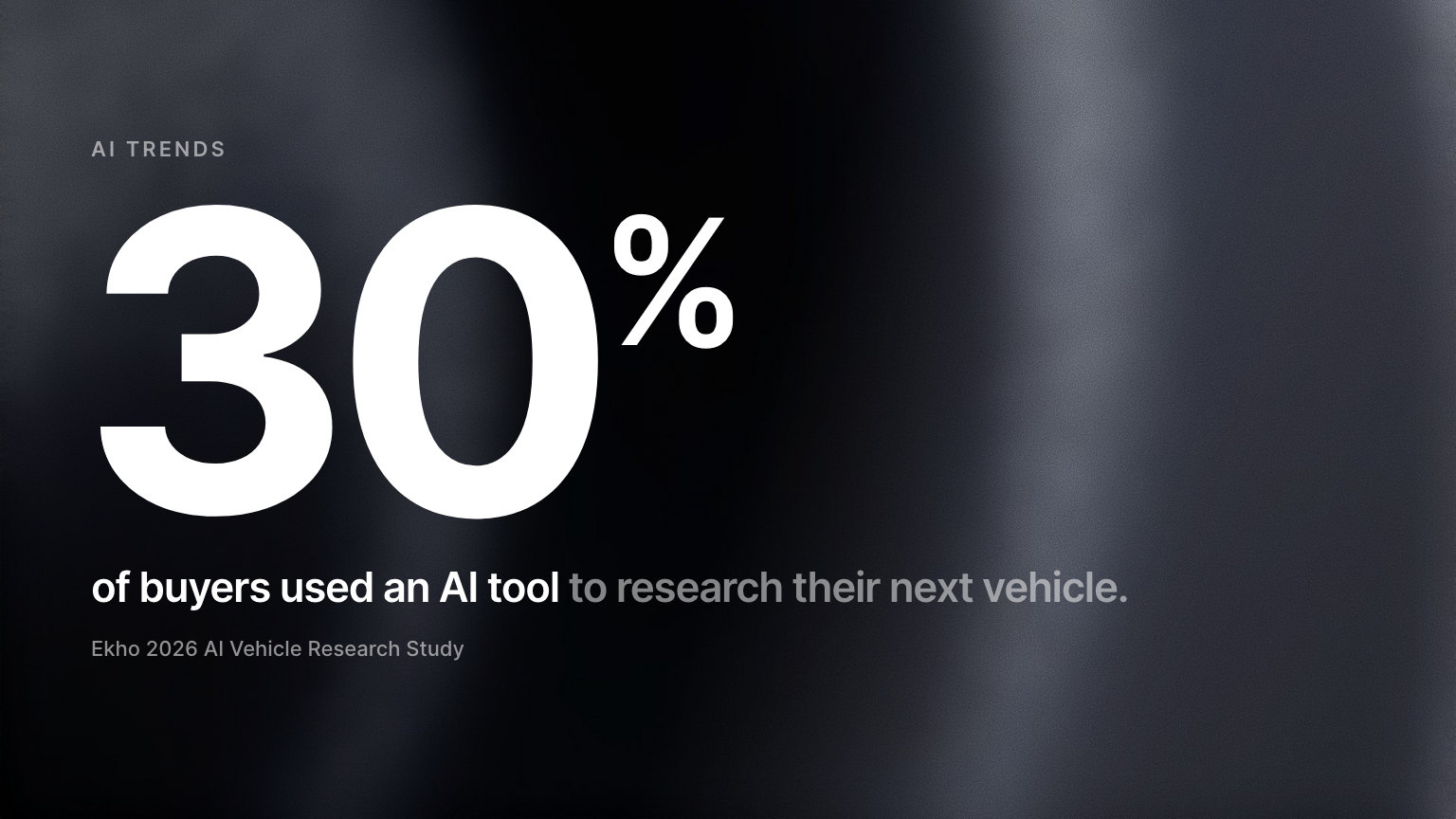

SEO and GEO share roughly 70% of their inputs. The 30% that's different is where 2026 dealership website strategy actually lives. A clear-eyed primer on what generative engine optimization is, what it isn't, and where it changes the work. Part of our Powersports Website Playbook.
The marketing officer at a powersports dealership has been hearing about GEO for the better part of a year now. Vendors are pitching it. Conference talks are dedicated to it. The CMO at the manufacturer call mentioned it three times. And the question that keeps surfacing internally is the right one: Is this actually different from SEO, or is it the same playbook with a new acronym?
The honest answer is both. SEO and generative engine optimization share most of their underlying signals, site speed, structured data, mobile-readiness, content depth, internal linking, freshness. Roughly 70% of the work is the same work. But the 30% that's different is genuinely different, and that 30% is where most of the strategic decisions live for a 2026 dealership website.
This guide is the strategic primer. What GEO is, what it isn't, where it converges with SEO, and the four practical areas where the divergence changes how you build, structure, and maintain the site. Written for the marketing leader who needs to walk into a strategy meeting with a clear position on the difference, not a vendor pitch.
What GEO actually is
Generative engine optimization, GEO, is the practice of structuring a website to be cited by AI search engines. Where SEO targets engines that surface ten ranked results in response to a query, GEO targets engines that synthesize a single answer from a small set of cited sources.
The engines that matter for GEO in 2026:
- ChatGPT with web search and shopping capabilities.
- Perplexity, purpose-built around source-cited answers.
- Claude with web browsing.
- Gemini and Google AI Overviews, Google's own generative surfaces, which sit alongside the traditional ten blue links.
- Copilot and other Microsoft-vertical surfaces that tap Bing's index.
When a buyer asks one of those engines "what's the best UTV for trail riding under $20K" or "find me a Polaris dealer in Bozeman with a 2024 RZR in stock," the engine doesn't return a results page. It composes an answer, and it cites the websites it pulled from. The dealership website is either in those citations, and therefore in the buyer's research, or it isn't.
GEO isn't a replacement for SEO. It's a parallel track that runs alongside it. The same buyer who asked ChatGPT for trail-riding recommendations on Tuesday will run a Google search for "[shortlisted model] dealer near me" on Friday. The dealership has to win both surfaces. The good news is that most of the work overlaps; the strategic question is what you do about the part that doesn't.
The 70% that's the same
The shared inputs are the foundation of any 2026 dealership website. Both SEO and GEO need them.
Site speed
Both engines weight speed. Google has weighted Core Web Vitals as a ranking signal since 2021. AI engines pulling sources in real time skip slow pages, a 5-second LCP page gets dropped in favor of a 1.5-second page even when the slow page has stronger content. The four numbers, LCP under 2.5s, INP under 200ms, CLS under 0.1, TTFB under 600ms, are eligibility for both surfaces. (See Core Web Vitals for powersports dealer websites for the full thresholds and provider failure modes.)
Structured data
Schema markup is the language both surfaces use to extract structured facts from a page. Google reads it for rich results and ranking; AI engines read it because parsing JSON-LD is faster and more reliable than parsing freeform body copy. Both surfaces care about valid Vehicle, Offer, LocalBusiness, AutoDealer, and Organization schema. The difference, as we'll get to, is how much weight each engine puts on it.
Mobile-readiness
Buyers research powersports on mobile, typically 70–80% of dealership traffic. Mobile-first indexing is the default in Google. AI engines fetching sources prioritize the mobile rendering of a page when checking eligibility. Mobile-broken pages aren't eligible for either surface.
Content depth
Thin content fails on both surfaces. A VDP with three lines of OEM boilerplate doesn't rank in Google and doesn't get cited by ChatGPT. The threshold isn't word count, it's whether the content actually answers the questions a buyer brings. Use-case context, fitment notes, segment specifics, real photography. Depth in service of the buyer's question is depth that compounds across both surfaces.
Internal linking
Both surfaces use internal links to understand site architecture. The pillar-and-cluster pattern that's been SEO best practice for a decade, one canonical page per topic with deep links from supporting pages, also serves GEO. AI engines walking a site to understand its scope use internal links the same way Google's crawler does.
Freshness
Recently updated content outranks stale content for time-sensitive queries; AI engines also favor fresh sources when the question is time-bound ("2025 [Make] [Model] price"). Editorial cadence, monthly updates to category pages, weekly inventory updates, daily sold-unit hygiene, serves both.
If a website is doing the 70% well, both surfaces work. If it isn't, neither does. The 30% conversation isn't worth having until the 70% is solid.
The 30% that's different
Where GEO diverges from SEO is in four areas. Each one represents a meaningful change in how the website should be built, structured, or maintained.
1. Page-level clarity weighs more in GEO than in SEO
In a ten-blue-link world, the engine surfaces the page and the buyer reads it. Ambiguity in the body copy is fine, the buyer can sort through nuance, hover for clarification, scroll. The engine's job is to find the right page; the page's job is to inform the buyer who already showed up.
In a generative-answer world, the engine extracts the fact from the page and synthesizes it into a one-paragraph response. Ambiguity costs you. If the page says "prices start as low as the high $20Ks for properly equipped models, depending on trim," the AI engine has to decide whether to cite that as $20,000, $28,000, or "contact the dealer for pricing." Most engines will either pick the most pessimistic interpretation or skip the page in favor of a clearer source.
What this changes:
- Direct factual answers in the body copy. The price is $24,499. The horsepower is 119 hp. The model year is 2026. Hedging language and conditional pricing belong in the financing section, not in the spec block.
- Clear answers to the obvious questions on every page. Buyers ask "what does this cost," "what's the weight," "what's it for," "where is the dealer." Each of those questions should have a direct, unambiguous answer somewhere visible on the page.
- FAQ blocks at the bottom of pillar and category pages. GEO engines pull FAQ-formatted content into answers at high rates. A 5-question FAQ on a category page about "trail UTVs under $20K" is cited dramatically more often than the same content embedded in body paragraphs.
- Headlines and summaries that state the page's purpose plainly. The H1 and the dek answer what is this page about in clear language. AI engines synthesize from the top of the page; opaque headlines reduce citation rates.
The summary version: write for the answer, not just the click.
2. Structured data is doing more work in GEO
Both surfaces use schema. The difference is the weight.
!Write for the answer, not just the click.
In SEO, schema is a tiebreaker. Two pages with similar content quality, similar links, similar speed, the one with valid Vehicle schema gets the rich result and ranks slightly higher. Schema is a multiplier on top of a content foundation; without the content underneath, schema alone doesn't rank.
In GEO, schema is closer to a primary input. AI engines extracting facts from a page prefer JSON-LD over body copy because JSON-LD is unambiguous, machine-readable, and validated. A page with a clean Vehicle JSON-LD block, name, model, vehicleConfiguration, vehicleEngine with enginePower, mileageFromOdometer, offers with price and priceCurrency, gets cited at materially higher rates than a page that has the same facts in body paragraphs only.
What this changes:
- Schema coverage on every indexable page, not just VDPs. SRPs need
ItemListandBreadcrumbList. Location pages needLocalBusinessorAutoDealer. The homepage needsOrganization. Editorial pages needArticleorFAQPage. Every page should pass through a schema validator. - Schema completeness over selective fields. A
Vehicleschema withnameandpriceis fine for SEO; for GEO, fillvehicleConfiguration,vehicleEngine,numberOfAxles,mileageFromOdometer,cargoVolume,seatingCapacity, every field that's accurate. Each populated field is a fact the AI engine can pull cleanly. - Schema-feed-content consistency. The schema, the visible body copy, and the inventory feed all have to agree. AI engines explicitly down-weight pages where the schema says one thing and the page says another. (See the powersports schema cookbook for the full markup.)
Schema is the highest-ROI investment most dealership sites can make in 2026, and it's GEO that pushes it past SEO in priority order.
3. Sold-unit accuracy is a GEO-specific signal at a different scale
In SEO, an old sold-unit page that's still indexed is a minor problem. The page may rank for a model query, the buyer clicks, sees the unit is sold, leaves. The dealership loses the click but the page doesn't damage the rest of the site materially.
!In GEO, schema is closer to a primary input than a tiebreaker.
In GEO, the same problem is much larger. Once an AI engine cites a page that turns out to be sold, the engine learns a lesson, this source's availability data is unreliable. The down-weighting often isn't unit-by-unit; it can extend to the entire dealership domain. Several months of stale sold-unit pages can damage the site's overall citation eligibility for inventory queries.
The implication is that sold-unit hygiene moves from housekeeping to operational priority in GEO. The standards:
- Sold units flip
availabilitytoOutOfStockwithin 24 hours of sale, or the URL returns 410 Gone. - The visible body copy reflects the change. A page saying "Available, Reserve Yours Today" with a schema flag of
OutOfStockis the worst-case scenario; the engine reads the contradiction as data unreliability. - Sitemap and feed sync. Sold units leave the sitemap and the inventory feed in the same hygiene window.
What this changes for the dealership:
- Sold-unit hygiene is a daily operational metric, tracked alongside inventory turn and lead response time.
- The CMS has to support real-time
availabilityupdates, not nightly batch syncs. - The decision tree for sold pages, 410 vs.
OutOfStockvs. redirect to similar inventory, is documented and consistently applied. (See inventory feed enrichment and sold-unit hygiene for the full decision logic.)
This single area is the most damaging GEO problem on most provider-template sites and the most under-prioritized fix.
4. Local entity resolution carries more weight in GEO
In SEO, local search is its own surface, the local pack, the GBP card, geo-modified queries. The local entity infrastructure (GBP, NAP, location-page schema, reviews) drives local-pack ranking. The non-local SEO of the dealership, domain authority, link equity, content, is largely separate.
In GEO, local entity infrastructure is a primary input across many query types, not just local-intent ones. When a buyer asks ChatGPT for "a snowmobile dealer in [region] that carries [brand]," the engine runs entity resolution against the local graph, pulling from GBP, schema on the website, NAP across citation sources, review profile, and the consistency between all of those. The cleaner the entity graph, the higher the citation rate. Inconsistencies actively reduce confidence.
This applies even on queries that don't sound local. A query like "compare 2024 [Make] [Model A] vs [Make] [Model B]", which on its face is a research-and-comparison question, not a dealer search, often pulls dealer source pages where local entity confidence is high. A dealership with a clean entity graph gets cited even on non-local queries because its source pages are trusted.
What this changes:
- NAP consistency is a graph problem, not a single-page problem. Byte-identical address, phone, and name across the website, GBP, OEM dealer locators, Bing Places, Apple Maps, Yelp, social profiles, and citation directories. "Suite 200" vs. "Ste 200" counts as a fail. (See local SEO for powersports dealerships for the full audit workflow.)
- Location pages need
LocalBusinessorAutoDealerschema withgeocoordinates,openingHoursSpecification,areaServed, andsameAsarrays linking authoritative profiles. - Review profile is part of the entity graph. Sustained 4.5+ averages with consistent recent velocity reinforce the entity; long quiet periods or declining ratings degrade it.
- Reviews and posts on GBP feed back into AI engine confidence, not just into the local pack.
The strategic point: local entity infrastructure isn't only local SEO infrastructure anymore. It's the foundation of GEO trust.
Run the audit, see your traditional SEO and GEO scores side by side
The argument of this piece is that the 70% and the 30% have to be measured together, not in isolation. The Website Grader is built to do exactly that: a traditional SEO health pass, an AI-search visibility audit, and a performance check on the same URL, returned together. Useful as a baseline before you decide where the marginal hour of work belongs this quarter.
What this means strategically
The marketing leader's takeaway from the 70/30 split:
Don't run two programs. Do not build a separate "GEO team" alongside the SEO team and split the budget. The 70% of shared inputs means the foundational work, speed, schema, mobile, content depth, internal linking, freshness, is one program serving both surfaces. Two teams doing the same foundation work twice is wasted spend.
Re-prioritize the 30%. The four areas above, page-level clarity, structured data weight, sold-unit accuracy, local entity resolution, should move up the priority list. Each is high-leverage on GEO without sacrificing SEO. The opposite isn't true, there are SEO tactics (e.g., link-velocity acquisition campaigns) that don't move GEO and can sometimes hurt it.
Audit the 70% first, then the 30%. If the foundation is broken, slow site, invalid schema, thin content, the GEO investments don't compound. The 30% of GEO-specific work assumes the 70% is in place.
Measure both surfaces. GEO measurement is still maturing, the engines don't expose impression and citation data the way Google does. Periodic manual probing, query a sample of buyer questions in ChatGPT, Perplexity, and Gemini, document whether the dealership shows up, is the operational standard until the analytics tools catch up. The 90-day plan in the pillar walks through how to baseline this.
Stop reading vendor copy on GEO and start reading the citations. The most reliable signal of how an AI engine ranks sources is to look at what it cites. Run twenty buyer queries. See which dealerships keep showing up in the answers. Look at their sites. The pattern emerges quickly.
What this gets you
A dealership that's running both programs as one, solid 70% foundation plus deliberate 30% optimization, wins more research traffic in 2026 and 2027 than a dealership running either in isolation. The compounding goes both ways: SEO investments make the site cleaner, which improves GEO; GEO investments (schema completeness, page-level clarity, entity graph hygiene) reinforce SEO. The dealerships getting cited by AI engines are typically also outranking on Google.
The strategic mistake is treating GEO as either the same as SEO or a separate discipline. It's neither. It's the next layer on top of a 2026 SEO program, and the layer is real.
What to ask your website provider
Three questions:
- What's specifically built into your platform for AI-search citation eligibility? Listen for concrete answers, schema completeness across page types, FAQ blocks on category and pillar pages, server-side rendering, sold-unit hygiene SLAs. Vagueness is the answer.
- Show me a sample dealer's appearance in ChatGPT, Perplexity, and Google AI Overviews on representative buyer queries. Providers with serious GEO posture can demonstrate this. Providers without will deflect.
- How do you maintain schema-feed-content consistency in real time? The provider that can answer this concretely, what triggers updates, what the latency is, how conflicts are resolved, has thought about GEO. The provider who hasn't is going to spend the next 18 months retrofitting.
This guide is part of our Powersports Website Playbook, the full strategic frame, audit, 90-day plan, and provider questions for ranking and getting cited by AI search in 2026. The 30% that's different in GEO touches several specific implementation areas: structured data weighting (see the powersports schema cookbook), speed thresholds as eligibility (see Core Web Vitals for powersports dealer websites), and sold-unit accuracy as a citation-trust signal (see inventory feed enrichment and sold-unit hygiene).
Frequently asked questions
No. <em>Replace</em> is the wrong frame. Traditional Google search remains the largest single research surface and isn't going anywhere. The shift is from one dominant surface to several, Google plus ChatGPT, Perplexity, Claude, Gemini, AI Overviews, each with material share of buyer research time. The dealerships winning in 2026 optimize for the multi-engine reality, not bet on one surface. Roughly 70% of the optimization work serves both surfaces; 30% is GEO-specific re-prioritization.
Page-level clarity. In SEO, the engine surfaces the page and the buyer reads it; ambiguity in the body copy is fine because the human can sort through nuance. In GEO, the engine extracts the fact from the page and synthesizes it into a one-paragraph answer; ambiguity costs you. Direct factual answers, FAQ blocks, clear headlines and summaries, and complete schema markup all matter more in GEO than in SEO. Write for the answer, not just the click.
The signals overlap with SEO ranking signals but with different weights. Speed (slow pages get dropped), valid and complete schema (JSON-LD is the engines' preferred extraction format), sold-unit accuracy (stale availability data damages the entire source's trust), and local entity resolution (NAP consistency, GBP, reviews, location-page schema) all carry more weight in GEO than in pure SEO. Content depth and freshness matter in both surfaces.
Layer it into existing work. The 70% of shared inputs means the foundation, speed, schema, mobile, content, links, freshness, is one program serving both surfaces. A separate GEO team duplicates effort. The right operating model is one program with the GEO-specific re-prioritization (page-level clarity, schema weight, sold-unit hygiene, entity resolution) baked into the priority order.
Manual query sampling is the operational standard until measurement tools mature. Run a fixed set of buyer queries, <em>"best UTV dealer in [city]," "compare [Model A] vs [Model B]," "where to buy a [year] [Make] [Model] near [region]"</em>, across ChatGPT, Perplexity, Claude, and Gemini. Document whether the dealership appears, in what context, and which competitor sources are cited. Run the same queries quarterly to track movement. The 90-day plan in the pillar uses this baseline as the starting position.