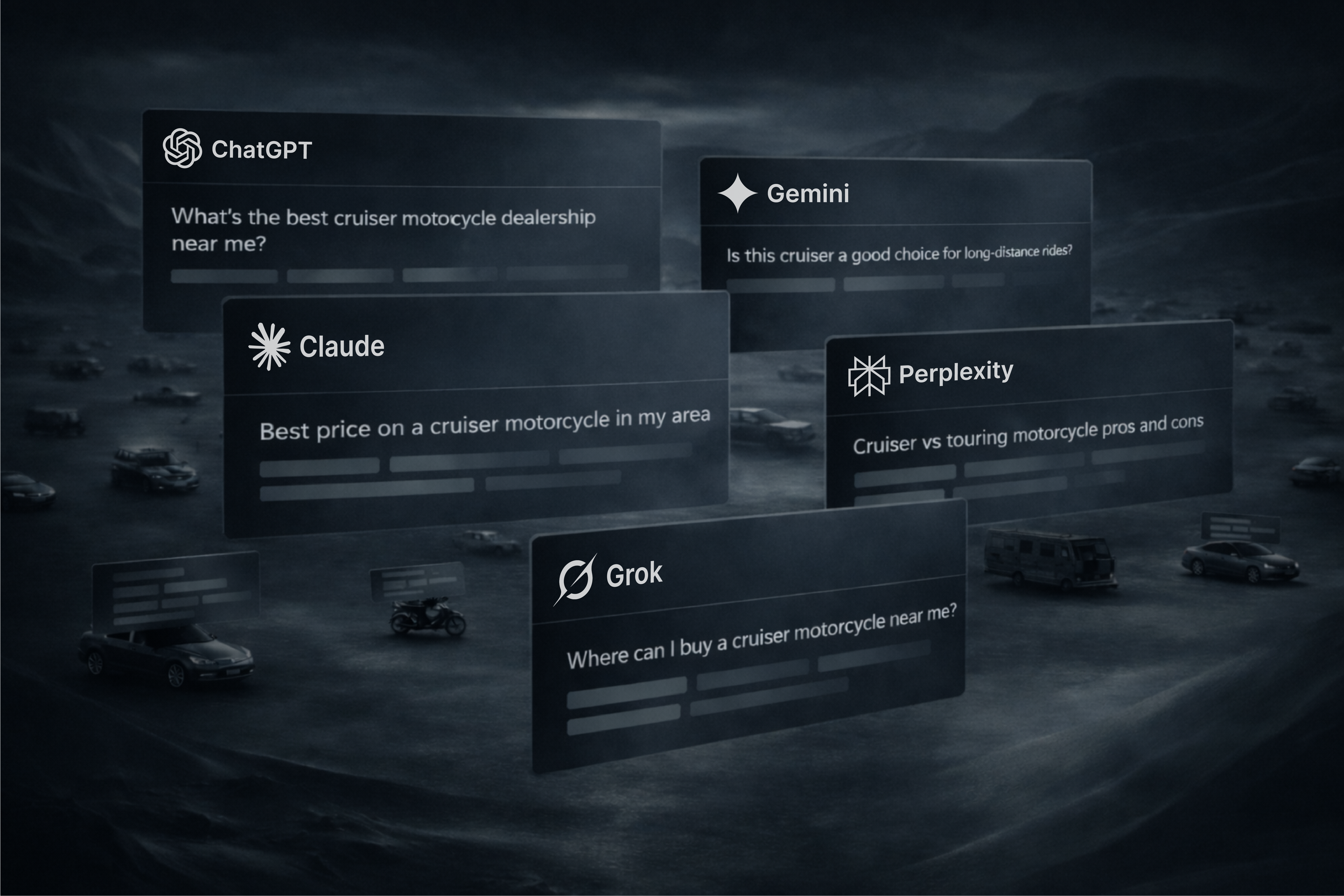
AI is rapidly reshaping vehicle shopping. Ekho’s research shows that 30% of buyers now use generative AI—led overwhelmingly by ChatGPT—to research vehicles, resulting in higher intent earlier than ever. AI is becoming the front door for discovery, while dealership inventory listings are evolving into the system of record for AI visibility and the place where informed buyers expect seamless, end-to-end transactions.
Key Takeaways
- AI is now a core part of vehicle research: 30% of shoppers used an AI search engine tool during their buying journey, signaling that AI is already shaping how buyers explore vehicles.
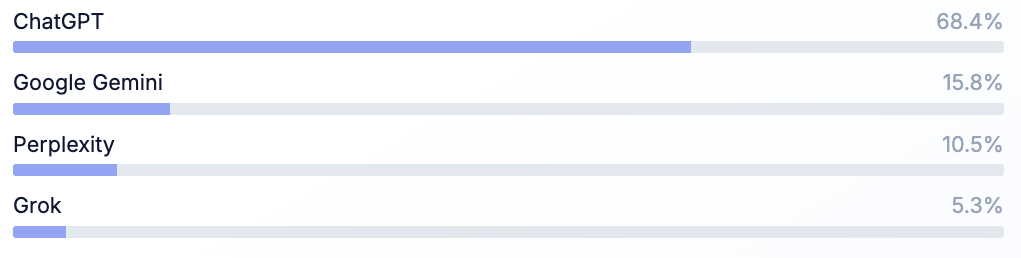
- ChatGPT dominates AI-driven research: Among AI users, 68.4% relied on ChatGPT — more than all other AI tools combined — making it the primary environment for AI-based vehicle discovery.
- Buyers are reaching higher intent earlier: AI was used more than twice as often as marketplaces (30% vs. 12.7%) and more often than OEM or dealer sites (15.8%), meaning many shoppers arrive at dealer websites already informed and closer to purchase.
- The dealership inventory listing's role is shifting: As AI becomes the starting point for research, dealer websites must both supply clean, structured data that AI can trust and serve as a seamless, transaction-ready destination for high-intent buyers.
- AI is the front door; the website closes the sale: Shoppers increasingly start with AI and then move downstream to dealer and OEM sites to confirm details and transact.
- Ekho GEO helps dealers adapt to AI-driven discovery: Ekho GEO enables dealerships to benchmark AI visibility, compare against competitors, and identify steps to improve how they appear in AI search — helping capture the higher-intent demand AI tools are creating.
Introduction
The way people shop for vehicles is undergoing a revolution. Consumers are no longer relying solely on Google searches – many are now turning to AI chatbots and assistants as their first stop for research. Generative AI search usage is skyrocketing, growing 165× faster than traditional search; analysts predict AI-driven platforms could capture 75% of global search traffic by 2028. Given this rapid shift, Ekho set out to understand how today’s vehicle shoppers are using AI tools in the buying journey.
Ekho – the end-to-end vehicle commerce platform for dealers – has a front-row seat to emerging shopper behaviors. We serve all types of dealerships, from powersports and marine to RV and outdoor equipment, so we see trends across categories. To better quantify the AI trend, we conducted a new research study focused on AI usage during vehicle purchase research. This report presents the key findings of that study. It builds on our earlier analyses – From Google to ChatGPT: How Vehicle Discovery Is Quietly Shifting and Why AI Search Is Fundamentally Different from SEO, and Why That Matters for Dealers – which highlighted the growing influence of conversational search in vehicle shopping. We're also introducing Ekho GEO, a new product born from these insights, which helps dealers benchmark and improve their visibility in AI-driven search results. Together, these pieces aim to equip dealers with data and strategies for the AI era of vehicle buying.
Key Findings
Our 2025 year-end survey of in-market vehicle shoppers revealed striking evidence of AI’s growing role in vehicle purchase decisions:
- 30% of buyers used AI tools during their research.
Nearly one in three respondents relied on at least one AI-powered search engine when researching their next vehicle, indicating growing trust in AI for answering vehicle-related questions. - ChatGPT dominated AI tool usage (68.4% share).
Among shoppers who used AI, 68.4% used ChatGPT — far surpassing other assistants. Google’s Gemini ranked second, followed by Perplexity and Grok, each with significantly lower adoption.
- AI far outpaced other discovery channels.
AI was used by 30% of shoppers, compared to 12.7% for marketplaces. YouTube (25.3%) and social media (16.2%) remained relevant but did not surpass AI usage.
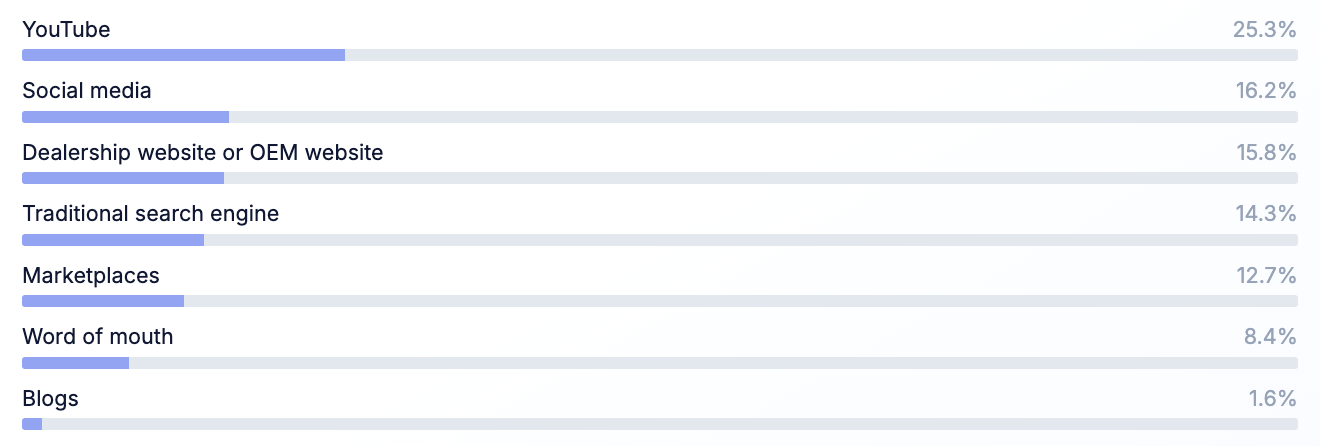
These findings signal a clear shift in behavior: vehicle research is moving toward an “ask-and-answer” model rather than link-based browsing.
How Buyers Use AI Tools
Beyond the raw numbers, our study examined how shoppers actually use AI during the purchase journey. By analyzing real prompt sequences, we identified a common AI-assisted research flow that unfolds across four phases.
Phase 1: Open-Ended Exploration
In the earliest stage, shoppers use AI to get oriented and understand their options, often before they know what specific product they want. Typical prompts include:
“how should I choose a dirt bike?”
“what should I look for in my first ATV?”
At this stage, AI helps buyers learn basic concepts and narrow the field. More experienced shoppers often skip this phase and begin further down the funnel.
Phase 2: Deep Dives into Specific Models
Once buyers have a shortlist, they turn to AI for detailed comparisons and model-specific questions, such as:
“is a 2-stroke better for motocross than a 4-stroke?”
“[brand a, model x] vs [brand b, model y] – which is more beginner-friendly?”
"What are the best UTVs under $15,000 for trail riding and hunting in dense woods?"
Here, AI synthesizes specs, reviews, and expert opinions into concise answers. Many shoppers told us they valued how quickly AI could summarize information that would otherwise require reading dozens of forum threads or articles.
Phase 3: Validating Pricing and Reputation
After narrowing their choice, buyers use AI to validate pricing, reliability, and trust. Common prompts include:
“[Model name] reliability and common problems”
“What’s a good price for a used [model name]?”
“Are [brand name] dealerships good about warranty service?”
We also observed frequent requests like:
“Please provide an honest review of [Model name]”
“[Model x] vs [model y]”
At this point, AI functions as a final check before moving forward.
Phase 4: Where to Buy (Local Discovery)
In the final phase, shoppers turn to AI with transaction-oriented, location-specific questions, such as:
“Where can I buy a [model name] near me?”
“best price on [model name] in the Bay Area”
"Is [dealership name] a trustworthy dealer?"
AI aggregates information from maps, dealer websites, and reviews, sometimes responding with answers like:
“Dealership X in your area has good reviews and carries the [model name]”
Some buyers also ask for buying advice, treating AI as a coach:
“what should I ask when I call the dealer”
“how to negotiate price on a new [model name]”
One moment from our survey responses captures this shift especially well. After researching a UTV extensively with ChatGPT, one shopper asked:
“Why can’t you just buy a UTV like a Tesla?”
The question reflected genuine confusion. After a streamlined, conversational research experience, the buyer expected the final step to be just as seamless.
This highlights a growing expectation gap. As AI helps buyers reach decisions faster and with greater confidence, Phase 4 carries more weight than ever. Buyers arrive informed, validated, and ready to act — and increasingly expect a clear, transaction-ready path forward.
Across all four phases, AI serves as an on-demand expert: first a guide, then a consultant, and finally a navigator. Many questions once answered by dealer websites, salespeople, or third-party content are now being answered directly by AI — reshaping how and where buying decisions take shape.
Comparison to Other Industry Research
Our findings closely mirror other recent studies on AI’s role in vehicle shopping. In 2025, Cars.com found that 44% of car shoppers had already used AI-powered tools during the buying process, and 97% said AI will influence their purchase decisions going forward. Similarly, CarEdge reported that roughly 1 in 4 buyers (25%) were actively using ChatGPT or similar tools, with about 40% of upcoming buyers planning to use AI in their search.
Ekho’s finding that 30% of vehicle shoppers used AI fits squarely within this range, reinforcing how quickly AI adoption has reached critical mass. Just a year or two ago, virtually 0% of buyers were using ChatGPT; today, a third or more are turning to AI for help. These studies also highlight why: Cars.com found 73% of AI users said the tools saved them time by turning natural questions into targeted results. Together, these findings make it clear that AI-driven discovery is not a fad — it’s becoming a core part of the vehicle-buying journey.
Why This Matters for Dealers
For dealerships and OEMs, the rise of AI-assisted shopping is a clear signal that traditional SEO and digital marketing are no longer enough on their own. As more shoppers use AI tools to ask questions and narrow choices, the role of the dealership website is evolving. It’s no longer just a place for discovery — it’s becoming the system of record that powers AI visibility and the destination where high-intent buyers complete transactions. Here’s why this shift matters and how dealers can respond:
- Discovery is changing — but dealership inventory listings still anchor it.
Buyers increasingly start with AI tools, asking questions like “the best mid-size pontoon boat for fishing.” While answers may appear directly in chat, AI systems rely heavily on structured, authoritative data from dealer websites and inventory feeds to generate those responses. This makes clean, accurate, and machine-readable inventory and content essential for being surfaced by AI. - AI is the new front door — the dealer website is the checkout.
Many shoppers begin with AI and then move downstream to a dealer’s website once intent is formed. In this flow, AI influences the decision, but the dealership website is where action happens. That puts pressure on dealer sites to support fast, frictionless conversion for buyers who are already informed and ready to act. - Answer engines vs. search engines: the website powers both.
Unlike search engines that present links, AI answer engines synthesize information into a single response. Whether a dealership is mentioned depends on content quality, data clarity, freshness, and trust signals — all of which are rooted in the dealership’s website and broader digital presence. - New optimization tactics are required — across the full stack.
Beyond traditional SEO, dealers must focus on Generative Engine Optimization (GEO): structuring inventory data for AI consumption, maintaining authoritative content, and enabling integrations that allow inventory to be syndicated into AI-driven platforms — while also supporting end-to-end transactions.
In short, AI doesn’t make the dealership website less important — it makes it more strategic. Dealers who pair strong AI visibility with transaction-ready infrastructure are best positioned to capture demand when buyers are ready to purchase.
Methodology
This research was conducted by Ekho in Fall 2025 to understand how real buyers use AI during their vehicle shopping journey. Key details include:
- Survey audience: Distributed across Ekho-integrated dealer and OEM websites, capturing 627 verified responses from active in-market shoppers.
- Vehicle types covered: Respondents represented a broad mix of categories including motorcycles, ATVs, UTVs, boats, RVs, golf carts, and outdoor equipment.
- Timing: The study ran October–November 2025, capturing a moment when tools like ChatGPT had been in mainstream use for roughly a year.
- Approach: The study combined structured survey questions with qualitative insights, including real AI prompts and select follow-up conversations with respondents.
By focusing on engaged buyers across diverse vehicle types, this methodology offers statistically grounded insights into how AI is reshaping discovery across the dealership landscape.
About Ekho
Ekho is the only dealer commerce platform built to sell vehicles end-to-end — not just collect leads. Often described as the Shopify for vehicle dealers, Ekho enables dealers across autos, powersports, marine, RV, and outdoor equipment to turn online demand into completed, compliant transactions. Ekho’s mission today: help dealers grow their businesses without growing headcount, by unlocking incremental volume online and increasing margins in-store.
Ekho’s platform consolidates what was once a fragmented dealer stack into a single system. Its 50-state sales processing engine automates financing desking, titling and registration, tax remittance, insurance verification, fraud detection, sales documentation, signature collection, and franchise compliance. Dealers using Ekho increase deal throughput, preserve F&I margin, and reduce manual back-office work through AI-powered automation.
Since launch, Ekho has processed tens of thousands of vehicle orders nationwide and partnered with leading U.S. dealers and publicly traded OEMs to drive incremental revenue and operational efficiency. The company has raised $17.3M from investors including JPMorgan, Activant, Winnebago Industries, Y Combinator, the Tesla Alumni Fund, and prominent dealer group owners across the country.
About Ekho's Website Grader
Ekho's Website Grader is Ekho’s Generative Engine Optimization (GEO) Analysis Tool, built for dealerships across auto, powersports, marine, RV, OPE, golf cart/LSV, and trucks to understand and improve how they appear in AI-driven search. The Website Grader functions as a diagnostic report card for the AI era, giving dealers visibility into how AI systems interpret, surface, and recommend their dealership and inventory.
The Website Grader can be used independently of the broader Ekho platform. Any dealership can run a free Website Grader report to see how they appear across AI search, traditional SEO, and core website health metrics. For dealers seeking ongoing insight, website grading will be available as a free subscription that provides continuous monitoring, competitive benchmarking, and actionable recommendations to improve AI visibility over time.
For dealerships using the broader Ekho Dealer platform, AI and SEO ranking and visibility becomes part of an automated commerce system designed for the AI era:
- Automated AI visibility optimization: Ekho applies GEO insights directly to a dealer’s website and inventory by restructuring listings, standardizing vehicle data, and enriching merchandising content for AI systems.
- A unified approach to AI discovery and execution: Ekho GEO identifies visibility gaps, while Ekho Dealer ensures improvements are implemented across the website, inventory feeds, and merchandising layer.
- A transaction layer for higher-intent, AI-influenced buyers: Ekho’s AI-powered Intelligent Inventory Merchandising system enables end-to-end transactions, helping dealers convert AI-driven demand into completed purchases.
Together, Ekho's Website Grader and Ekho Dealer support the full AI-driven commerce lifecycle — from discovery to conversion.
Sources
From Google to ChatGPT: How Vehicle Discovery Is Quietly Shifting Ekho.com
Why AI Search Is Fundamentally Different from SEO, and Why That Matters for Dealers - Ekho.com
AI Is Poised To Change How We Buy Cars - CarEdge
End-To-End Vehicle Commerce Platform for OEMs and Dealers - Ekho Raises $17.3 Million
Frequently asked questions
According to the study, 30% of in-market vehicle shoppers used an AI-powered search tool during their buying journey. This was more than double the usage of online marketplaces (12.7%) and exceeded visits to OEM or dealer sites (15.8%), indicating that AI has become a core part of how buyers explore vehicles.
Buyers use AI across four distinct phases: open-ended exploration to learn basics, deep dives into specific models and comparisons, validating pricing and reliability, and finally local discovery to find where to buy. Across all phases, AI serves as an on-demand expert that helps buyers reach higher intent earlier in the process.
As more shoppers start their research with AI tools, the dealership website's role is shifting from pure discovery to being the system of record that powers AI visibility and the transaction-ready destination for high-intent buyers. Dealers who are not structured for AI citation risk being invisible to a growing share of their future customers.
Generative Engine Optimization (GEO) is a new set of tactics that go beyond traditional SEO to help dealers appear in AI-generated answers. It involves structuring inventory data for AI consumption, maintaining authoritative content, and enabling integrations that allow inventory to be syndicated into AI-driven platforms.
Dealers can run a free Website Grader report to see how they appear across AI search, traditional SEO, and core website health metrics. The tool evaluates AI visibility, provides a competitor benchmark, and delivers a prioritized list of improvements to help dealers get cited by AI systems.
The study captured responses from active in-market shoppers across a broad mix of vehicle categories including motorcycles, ATVs, UTVs, boats, RVs, golf carts, and outdoor equipment. The survey collected 627 verified responses from shoppers on dealer and OEM websites during Fall 2025.