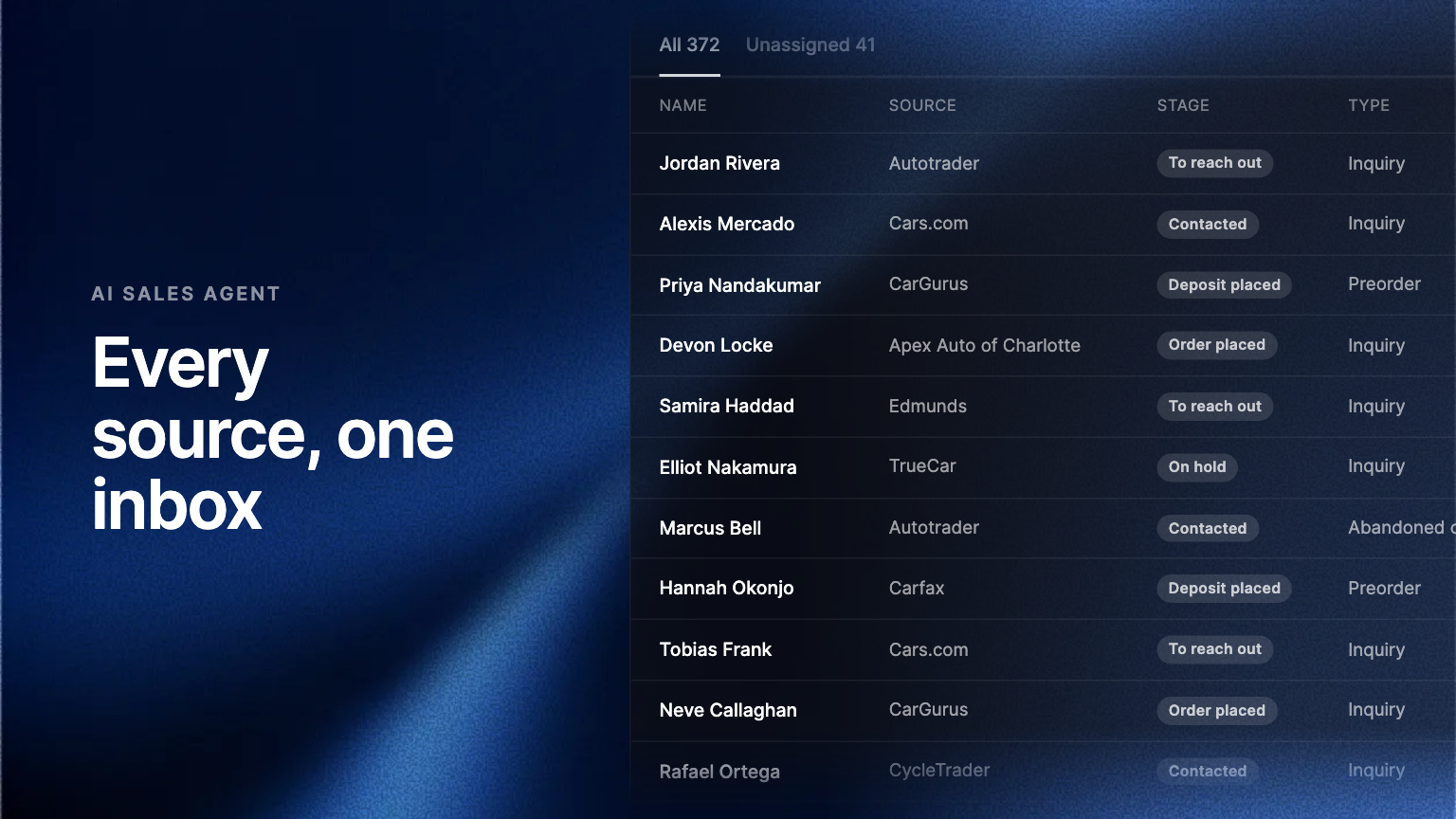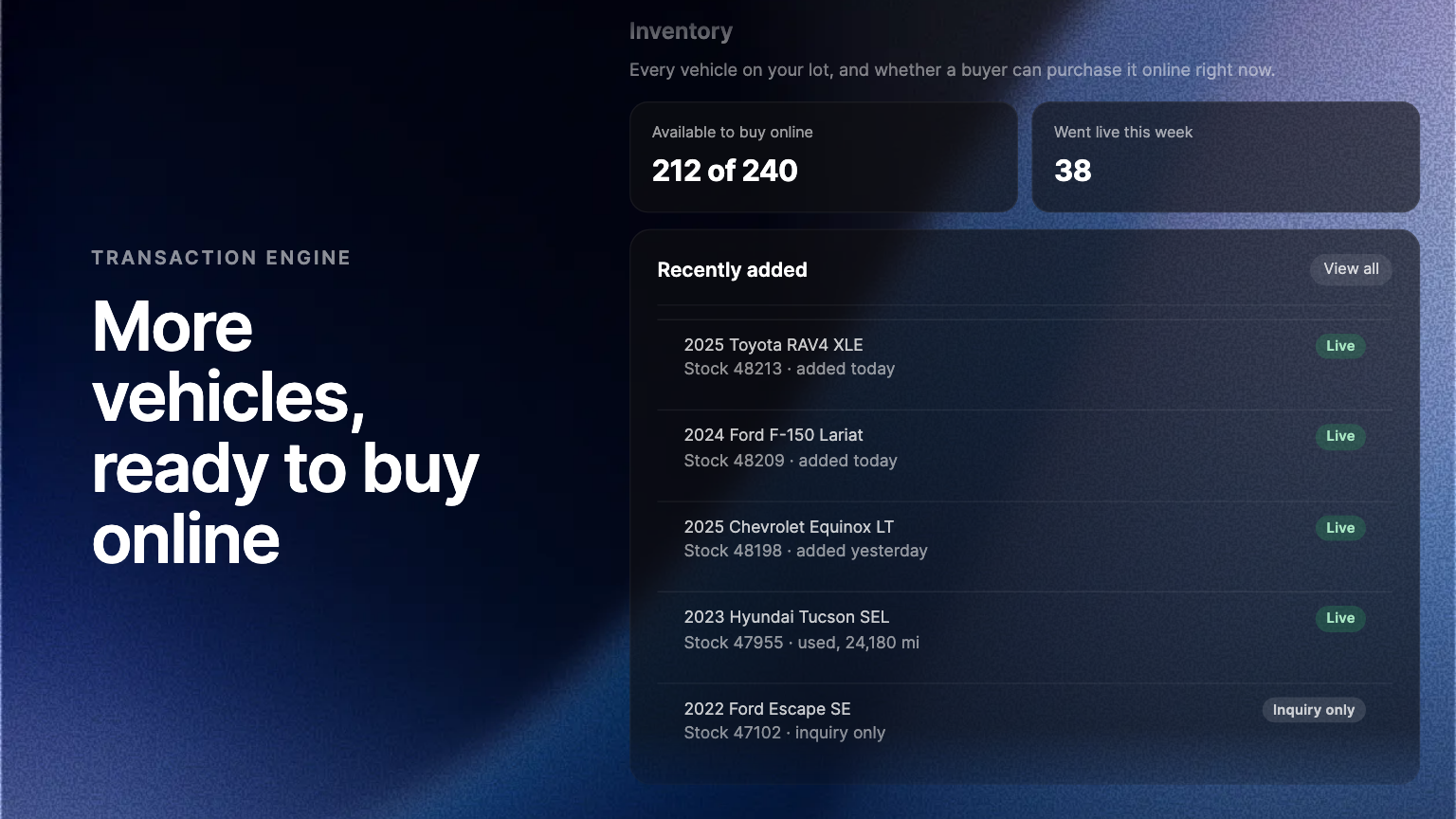
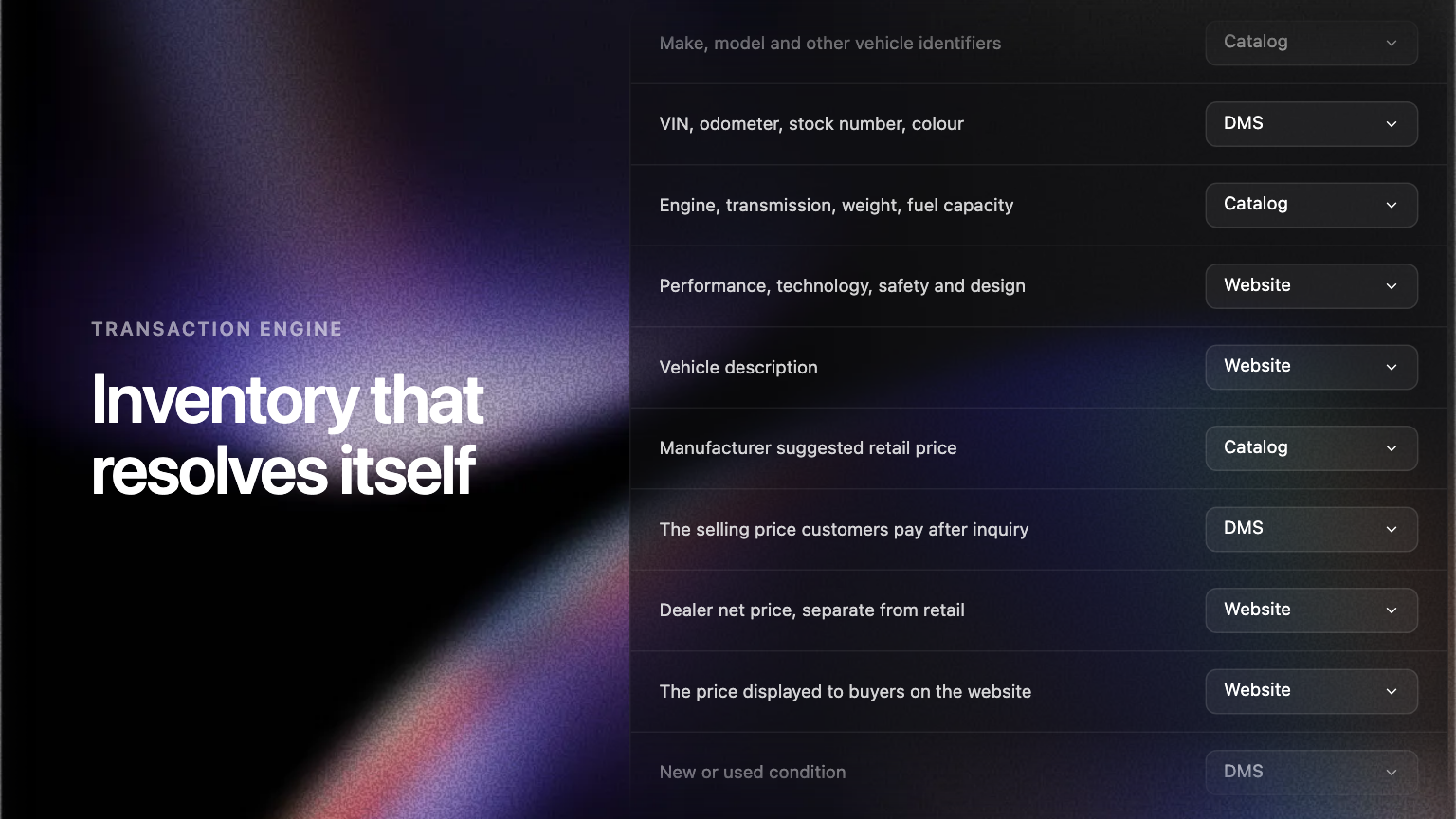
This release introduces Intelligent Inventory Merchandising, Ekho’s AI system that automatically matches and enriches client inventory from dealers, dealer groups, OEMs, and marketplaces to power both the AI Sales Agent and the Transaction Engine. By identifying, normalizing, and merchandising vehicles, even with inconsistent source data, the platform eliminates manual inventory mapping, accelerates onboarding, improves vehicle discovery, gives the AI Sales Agent deeper knowledge of every vehicle, and powers autonomous titling and registration. Clients benefit from faster processing, better search performance, and better-informed buyer conversations, while buyers experience a smoother path from research to road-ready.
What It Is
Intelligent Inventory Merchandising uses AI to automatically understand, normalize, and enrich incoming client inventory, whether it comes from a dealer, a dealer group, an OEM, or a marketplace, by connecting it to Ekho’s comprehensive vehicle database. That one foundation powers accurate operations, optimized merchandising, and downstream automation across the vehicle lifecycle, from the conversations the AI Sales Agent has with buyers to historically manual workflows like titling and registration in the Transaction Engine. As inventory flows in from client systems, our platform intelligently interprets each vehicle and resolves it to the correct underlying definition, even when source data is incomplete or inconsistent. When a vehicle falls outside existing coverage, the system automatically creates a fully merchandised record, ensuring every vehicle is immediately usable across discovery, conversation, purchase, and post-purchase workflows. This work benefits all current and future customers across both products.

Why It Matters
Titling and registering a vehicle requires precise information: engine specs, body style, weight, fuel type, emissions data, and more. Historically, matching client inventory to these detailed records required significant manual effort, and gaps or inconsistencies in inventory data often caused delays. Intelligent Inventory Merchandising fully automates this process, enabling faster, more reliable titling and registration regardless of what a client has in stock.
At the same time, accurate, complete, and expressive inventory data is critical to how vehicles are discovered in the first place. Search engines rely on structured metadata and high-quality descriptions to understand, rank, and surface listings to buyers actively researching specific makes, models, and configurations. By standardizing and enriching inventory data, Ekho ensures vehicles are clearly represented not only on client websites and marketplace listings, but also in the signals that search platforms use to determine relevance and visibility, helping clients attract more qualified buyers while shoppers find exactly what they’re looking for.
How It Works
When inventory syncs from a client’s DMS, inventory feed, or listings, our platform leverages an intelligent search system powered by vector embeddings, allowing us to use a variety of inputs from your system, such as vehicle descriptions, images, and identifying details, to perform smart lookups against our own database without requiring rigid data formats or standardized naming conventions. An AI model then confirms the best match.
When no existing record fits, the system automatically indexes the new make, model, and year. It aggregates data from multiple authoritative sources, leveraging a variety of AI models for information gathering, image selection, image enhancement, and processing. The result is a complete, merchandised vehicle definition with all the details required for autonomous titling and registration and for accurate conversations with buyers, added to Ekho’s database in real time.
Beyond correctness, we also optimize how each vehicle is merchandised for discovery and conversion. As part of this process, Ekho ensures vehicle metadata is aligned with what buyers actually search for during the research phase, and with what we know performs best on search engines. Using aggregated buyer intent signals and search behavior across platforms, we structure titles, attributes, and descriptions to maximize relevance, comparability, and organic visibility, helping vehicles rank higher and resonate more clearly with shoppers.
We also tailor qualitative vehicle content to each client using AI. Descriptions and highlights are dynamically informed by your business profile in Ekho, including your location, the brands you carry, your positioning, and the relative rarity of a given model in your market. Clients can further customize and update vehicle descriptions directly, ensuring listings reflect both local context and brand voice while remaining optimized for buyer intent and search performance.
Deeper Vehicle Knowledge for the AI Sales Agent
The same foundation gives the AI Sales Agent far deeper context on every vehicle it discusses. Each listing is matched to a canonical catalog record for its base model, which carries the foundational specifications from the manufacturer. On top of that, the agent layers the client’s own description of that particular vehicle: its condition, history, options, and listing copy, read in the context of the client’s store or marketplace.
The result is an agent that speaks about vehicles the way a knowledgeable salesperson would. It can answer a buyer’s question about towing capacity or trim features from the manufacturer’s specifications, then explain what sets this specific vehicle apart, such as a recent service, an added package, or a one-owner history, in the client’s own words. Buyers get accurate, specific answers whenever they ask, and clients get conversations that move toward a sale instead of stalling on basic questions.
What’s Next
This release lays the groundwork for significantly faster and more scalable inventory onboarding as Ekho continues expanding vehicle catalog coverage across segments, brands, and configurations. As the system encounters more real-world inventory, it becomes increasingly capable of understanding edge cases, rare models, and market-specific variants, reducing friction for clients regardless of what they sell.
More importantly, a complete and intelligent vehicle foundation unlocks a growing set of downstream use cases. For clients, this means richer merchandising, better discovery across search and marketplaces, more knowledgeable buyer conversations, faster time-to-list, and less operational overhead as inventory moves from arrival to sale. For Ekho, it enables deeper automation across the vehicle lifecycle, from pricing and incentives to financing, fulfillment, and compliance, while supporting new products that rely on clean, expressive, and continuously improving vehicle data.
Over time, intelligent inventory merchandising becomes the connective tissue between how vehicles are defined, how they’re discovered, how they’re discussed with buyers, and how they’re ultimately transacted, powering a more autonomous, scalable, and performant vehicle ops OS.
Frequently asked questions
Intelligent Inventory Merchandising is Ekho's AI system that automatically matches, normalizes, and enriches incoming client inventory, from dealers, dealer groups, OEMs, and marketplaces, by connecting it to a comprehensive vehicle database. It powers both Ekho products: the AI Sales Agent draws on it to speak knowledgeably about each vehicle, combining the manufacturer's specifications with the client's own description of that vehicle, and the Transaction Engine uses it to automate historically manual workflows like titling and registration.
The platform uses an intelligent search system powered by vector embeddings to interpret each vehicle from a variety of inputs such as descriptions, images, and identifying details. It performs smart lookups without requiring rigid data formats or standardized naming conventions, and an AI model confirms the best match even when source data is incomplete.
When no existing record fits, the system automatically indexes the new make, model, and year. It aggregates data from multiple authoritative sources using AI models for information gathering, image selection, and processing, creating a fully merchandised vehicle definition in real time that is immediately usable across all workflows.
The system structures vehicle titles, attributes, and descriptions based on aggregated buyer intent signals and search behavior. By aligning metadata with what buyers actually search for, it maximizes organic visibility and helps vehicles rank higher and resonate more clearly with shoppers during the research phase.
Yes, qualitative vehicle content is dynamically tailored using AI based on each client's profile, including location, brands carried, positioning, and the relative rarity of a given model in the local market. Clients can further customize descriptions directly while the system ensures listings remain optimized for buyer intent and search performance.