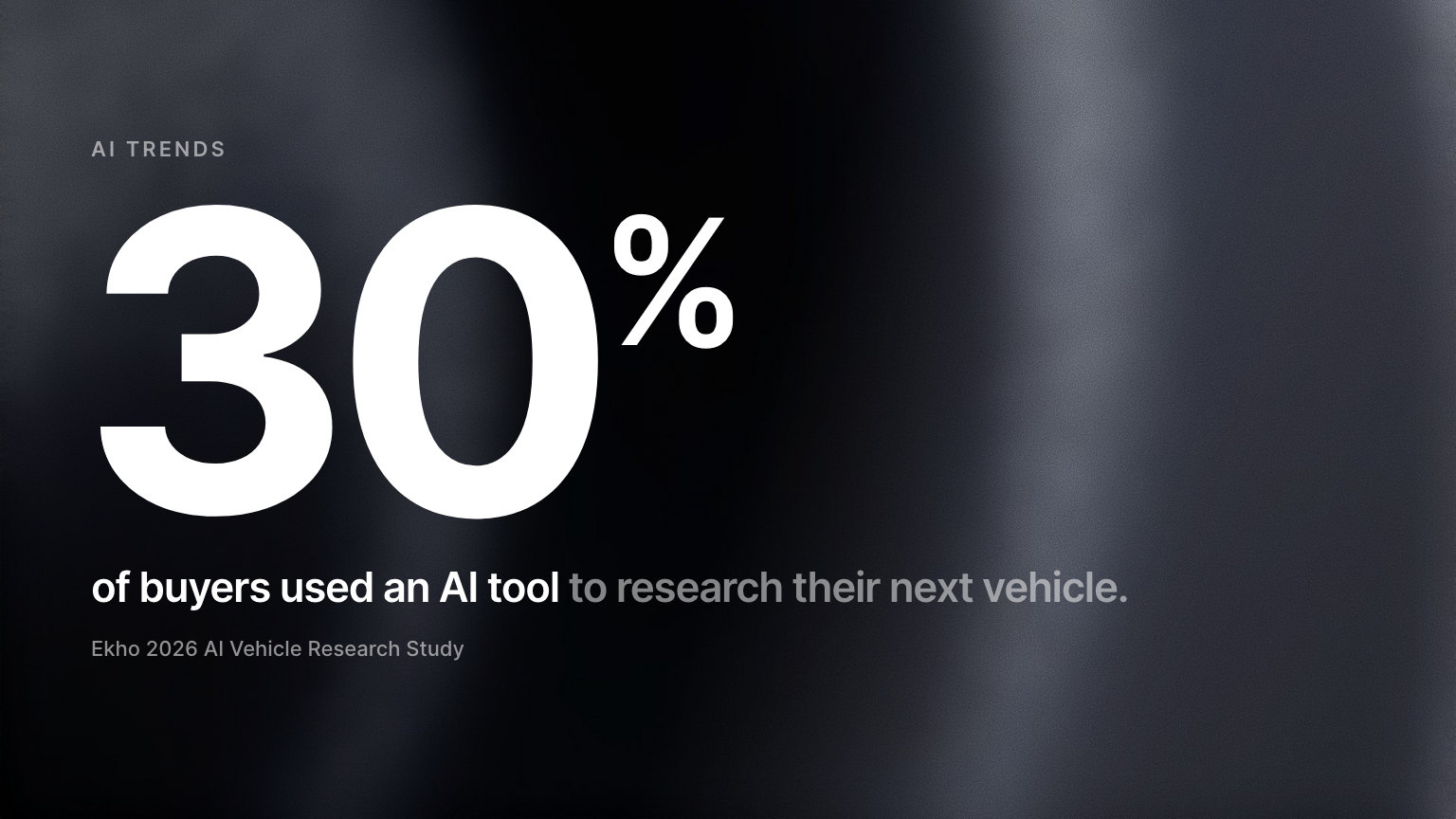

Agentic AI is the first dealership tooling that can credibly own a complete pre-sale funnel, not just a slice of it. This guide shows principals and GMs what an AI Sales Agent actually does, how it differs from chatbots and AI BDC tools, and the five criteria that separate a real platform from the next vendor email.
Most vehicle dealers, whether they sell motorcycles, pickups, fifth-wheel RVs, ski boats, or low-speed vehicles, still run their digital funnel like it’s 2018: a web form, an auto-reply, and a callback when the floor team has bandwidth. The buyers who don’t ghost first end up on a competitor’s site by lunch. AI Sales Agents change the math on every step of that funnel, and the dealers running them in production are seeing the lift.
This guide walks principals and GMs through what an AI Sales Agent actually does, how the agentic category differs from the chatbot and AI BDC tools you’ve been pitched, what production deployments look like today across powersports, RV, marine, automotive, and golf cart / LSV, and what to ask when you evaluate a provider. Ekho’s AI Sales Agent is the reference point throughout, but the criteria apply category-wide. For the dollars-and-cents version of this question, see our back-of-napkin ROI breakdown.
Why Traditional Vehicle Sales Models Are Lagging
The average vehicle buyer keeps getting older across every segment, and the buyers replacing them expect a sales experience that matches the digital-first standard they get from every other category. Whether the unit is a Honda CR-V, a Winnebago Class A, a Sea Ray cruiser, a Polaris RZR, or a Club Car LSV, today’s buyer starts on a phone, expects a real answer in minutes, and will put a deposit down before stepping into a showroom. The dealership transaction model has not kept up.
Buying any titled vehicle involves more than picking a unit. The transaction touches financing across multiple lenders, F&I products, state-specific titling and registration, and tax that varies by state, county, and municipality. Each vertical has its own version of that friction:
- Powersports. State-by-state motorcycle, ATV, UTV, and snowmobile titling rules vary widely; some states title a UTV, others don’t.
- RV. Interstate registration patchwork, weight-class thresholds, and the long-trip buyer pattern that puts the dealer’s customer 1,500 miles from home by week two.
- Marine. Hull-ID requirements and the split between state titling and U.S. Coast Guard documentation for larger vessels.
- Automotive. Franchise-law density, dealer-trade nuances, and the OEM lead-routing rules that wrap every retail conversation.
- Golf cart and LSV. The classification confusion between a non-titled cart and a street-legal low-speed vehicle, which changes title, registration, and insurance requirements in the same showroom.
Buyers feel the friction. Staff carry the same friction in reverse, with the added drag of legacy DMS workflows and patchwork compliance.
Layer in higher floor-plan costs, compressed margins, and inventory pressure, and the case for moving non-selling work off the floor team gets stronger every quarter. Industry research has consistently shown that response time is the single largest controllable factor in lead-to-close conversion. That math hits hardest in segments with higher inquiry volume per close and a buyer base that runs heavy on after-hours research, which is most of them now.
The question is what part of the funnel to automate first, and how far the automation can credibly go. The honest answer for 2026 is that the agentic AI category is the first AI tooling that can credibly own a complete pre-sale funnel for a vehicle dealership, not just a slice of it. The rest of this guide is about how to evaluate that claim.
Beyond Chatbots: Understanding the Rise of Agentic AI in Dealership Sales
An AI Sales Agent is not a chatbot. The category gets conflated, so it’s worth being precise.
Basic dealership chatbots run scripted responses inside a web chat window and route anything non-trivial to a form fill. AI BDC tools sit one tier above: they handle SMS and email follow-ups for a few weeks, then stop working when the lead doesn’t reply on schedule. Legacy AI BDC tools typically run a per-rooftop monthly subscription for a narrow slice of the funnel (SMS and email follow-up only). Both tiers are single-purpose, and both leave the rest of the funnel to the floor team or to nothing at all.
Agentic AI is different. The system understands context, takes action, and moves a buyer through the sales process across every inbound channel. It qualifies, it answers inventory and product questions, it pre-qualifies financing, it books appointments, and it hands a warm, qualified buyer to the floor team with the conversation history attached. It does not stop working when a buyer fails to reply on a particular day, and it does not stop working when business hours end. For a plain-language primer on the category, see what an AI agent actually is and what it can do for your dealership.
Mike Cunningham, Ekho’s Head of Business Development, ran a top-100 powersports dealership for 25 years before joining the company, with prior stops at Piaggio, Triumph, and Zero Motorcycles. The agentic model is what the vehicle retail floor has wanted for the better part of a decade: a system that does the qualification and pre-sale work the floor team cannot scale. The deepest evidence pool sits in powersports today, but the model maps directly onto auto, RV, marine, and LSV showrooms running the same response-time math.
The practical test is straightforward. Three questions. Can the system run financing pre-qualification end-to-end inside the conversation? Can it produce a calendar invite, not just an “interested in scheduling” tag? When the buyer goes silent for a week and then comes back, does the system pick up the prior context or start over? If any answer is no, it is a chatbot or a BDC tool, not an agentic system.
A Closer Look at Ekho’s AI Sales Agent
The Ekho AI Sales Agent runs on the dealer’s site, inside the buyer’s preferred channel, on the dealer’s existing inventory and pricing. The capabilities below are what the system does end-to-end, in production today.
Instant Lead Response and Qualification
Most vehicle leads go cold within an hour. The Ekho AI Sales Agent responds in seconds, across web chat and SMS, around the clock. It engages the buyer, answers inventory and product questions, and qualifies the lead before it lands in the CRM. The floor team picks up qualified, contextualized conversations. A buyer comparing a Ford F-150 to a Ram 1500 at 11 p.m., a family pricing out a Jayco travel trailer between bedtime stories, and a rider asking about a BMW R 1300 GS over lunch all get the same on-channel response. Speed is the whole game here, and your best buyers don’t keep business hours.
Pre-Qualification and Embedded Financing
Financing is where deals stall, in every vertical. Buyers arrive uncertain about what they can afford and what their payment looks like. Ekho’s AI Sales Agent runs financing pre-qualification inside the buyer’s conversation, with no hard credit inquiry and no impact on credit score, aligned with FTC guidance on credit-pull disclosures. The platform connects to a wide network of lenders covering auto, powersports, RV, and marine paper, and supports OEM promotional offers, including the automated stipulation clearance work that typically eats F&I time. The buyer sees real terms before they ever walk in.
Appointment Booking and Automated Follow-up
The agent schedules test rides, test drives, on-water demos, walkthroughs, service appointments, and sales-rep meetings inside the dealer’s calendar, sends confirmations and reminders, and handles reschedules. It also handles the everyday asks (“got a trade?”) and kicks off trade-in valuation in-line, whether the trade is a Kawasaki Ninja, a Toyota Tacoma, a Grand Design fifth wheel, or a Boston Whaler. The floor team’s calendar fills with appointments that have already been qualified, financed, and scoped.
Omnichannel Communication
Every interaction the AI has with a buyer, regardless of whether it started on web chat or SMS, lands in a single unified conversation inbox. When a buyer escalates or a dealer rep takes over, the rep sees the full thread. There is no re-explaining, no re-qualifying, and no dropped context. The same logic applies in reverse: a conversation that started over SMS at 11 p.m. picks up without restart when the buyer pulls up the dealer’s site from a desktop the next morning.
The agent runs against the dealer’s existing website out of the box, with the inventory feed wired in and the chat surface deployed where the dealer’s traffic already lives. For dealers who want to rebuild the front door entirely, Ekho’s AI-native Website platform is in iteration and available on a waitlist basis; it is designed for speed, mobile performance, search visibility (both classic SEO and the newer AI-search surfaces), and conversion.
Reporting and Performance Visibility
The platform exposes lead engagement, qualification rates, appointment conversion, and the most common questions buyers are asking, broken out by channel and by unit category. Sales managers see, in plain terms, where the funnel is leaking and where the AI is producing. The reporting is meant for dealer operators, not data scientists; the goal is to make tuning decisions inside the same week the dealer notices a trend, not after a quarterly review.
Handling the Legal Labyrinth: 50-State Compliance, Automated
The United States is fifty different vehicle commerce jurisdictions wearing a trench coat. Sales tax varies down to the municipality. Titling and registration rules vary by state, county, and vehicle type. A trailered jet ski, a street-legal motorcycle, a Class B motorhome, and a half-ton pickup follow four different paperwork paths in most states. Trying to run an end-to-end online sales workflow manually across that footprint, especially with cross-state buyers, is not a workflow problem. It is a regulatory problem.
Ekho spent over a year building a 50-state licensure and compliance framework before launching the platform in early 2024, working with regulatory counsel experienced in vehicle commerce. The result is the Transaction Engine, which sits underneath the AI Sales Agent and handles:
- Titling and registration. The system generates and files vehicle title and registration paperwork across all 50 states, adapting to each state’s specific rules and vehicle classes, including the LSV-versus-cart distinction, RV weight thresholds, marine hull-ID rules, and standard auto and motorcycle titling.
- Tax. The platform calculates, collects, and remits sales tax at state, county, and municipal precision.
- Fraud prevention. AI-driven signal analysis screens transactions for fraud before they hit the dealer’s books.
- Disclosure and recordkeeping. Every step is logged and audit-ready, aligned with FTC guidance on the disclosures regulators expect at each step of the sale.
Ekho also holds SOC 2 Type II, PCI DSS, and GLBA postures across the platform, which is the security floor most dealers cannot reasonably build in-house.
The practical impact: cross-state and online-originated sales stop being one-off projects. A buyer in Phoenix who finds inventory at a Nashville dealership can complete the purchase, with title and registration filed in their home state, taxes calculated to their municipality, and disclosure paperwork generated and stored, without the dealer adding headcount or a compliance vendor. The same workflow applies to an auto group across Texas, an RV dealer in central Florida fielding inbound from Georgia and Alabama, or a marine dealer on the Carolinas coast taking Massachusetts and Pennsylvania orders. The compliance work is uniform; jurisdictional differences are handled by the platform underneath.
What This Looks Like in Production
The deepest production evidence today is in powersports, where Ekho’s first dealer customers have been running the platform longest. The operational pattern carries to auto, RV, marine, and LSV dealers running the same response-time math.
Triumph Cleveland: 24/7 Sales in Action
Triumph Cleveland, one of the top Triumph dealers in the country, runs Ekho’s AI Sales Agent against a website that sees roughly 35,000 visitors per month. The agent works every inbound lead around the clock, qualifies prospects before they reach a human, and routes only conversation-ready buyers to the floor team. Test rides, closes, and high-intent service appointments are what lands on their calendar instead of triage.
The floor team used to spend the first hour of every shift triaging the prior night’s web inquiries: which leads were tire-kickers, which were ready, which had financing questions that needed an F&I hand-off. The AI Sales Agent does that triage in real time, overnight, with financing pre-qualification already done by the time the human team walks in. Scott Janca, who runs the dealership, has described it as the first piece of software in 20 years that gave his floor team back time instead of taking it.
Evinmotors and Massimo Motor Sports: Online Revenue at Scale
Evinmotors runs the Ekho platform end-to-end. Their General Manager, Justin Massey, put it plainly: “Ekho is the future, and you can either join it or get run over by it.” Massey has cited closing units at 12:30 a.m. as a routine outcome, which is the kind of thing the floor team is not on the clock to do. Massimo Motor Sports has reported strong ROAS gains running compliant online sales through the platform, with month-over-month conversion growth.
Dealers running Ekho’s AI Sales Agent route higher-quality leads to their teams and recover inbound volume that would otherwise time out. The same lift is showing up in the auto, RV, marine, and LSV dealers ramping on the platform: shorter F&I queues, after-hours volume that gets answered, and floor teams spending their hours on qualified buyers instead of triage.
Expanding Reach: Maeving, Stark Future, and Dust Moto
For OEMs and new-entrant brands trying to crack the U.S. market through dealer channels, Ekho is the path. Maeving, the best-selling electric motorcycle brand from the UK, used the platform to enter the U.S. market and route its first sales through dealers within a month, with financing, registration, and insurance handled in-line. Stark Future, maker of the Varg motocross bike, launched nationwide U.S. sales through dealers in roughly two weeks, with the system automating tasks like VIN assignment. Dust Moto launched nationwide preorders for its Hightail model through Ekho, mapping demand to inform dealer rollout. The same pattern applies to a new RV builder, a marine OEM running a regional pilot, or an LSV brand testing a U.S. footprint outside the legacy Club Car and E-Z-GO channels.
The pattern across all three named OEMs: the dealer is in the value chain from day one. The OEM brings demand. The dealer fulfills, services, and owns the relationship.
Buyer Experience
Zach Hill, a tech executive, made his first vehicle purchase through a dealer running Ekho and described the financing and DMV side as something he “forgot even happened.” James Barrett, a long-time buyer purchasing from Hawaii, completed his transaction through an Ekho-powered dealer and noted how clear and manageable the process stayed even from outside the continental U.S. The recurring feedback across buyer interactions is the same: fast, transparent, and the buyer stayed in control of a major purchase from start to finish.
For the dealer, that buyer experience is downstream of the operational system. The buyer’s perception of a low-friction process is the result of the AI Sales Agent surfacing the right financing options, the Transaction Engine handling the DMV side without paperwork churn, and the floor team showing up at the closing meeting with everything pre-built. Buyers who experience that workflow tend not to go back to the old one.
Evaluating an AI Sales Agent for Your Dealership
Five criteria separate a useful AI Sales Agent from the next vendor email you’ll delete.
- End-to-end coverage, not a single funnel slice. Confirm the system handles engagement, qualification, financing pre-qualification, appointment booking, and post-sale workflow, on one platform. Tools that handle only SMS follow-up will leave the rest of the funnel to your floor team or to nothing at all.
- 50-state compliance built in. Titling, registration, tax remittance, and disclosure workflows have to be codified per jurisdiction and per vehicle type. Ask the provider how the platform handles cross-state buyers, how it handles your vertical’s specific rules (LSV versus cart, marine hull-ID and Coast Guard split, RV weight classes, motorcycle and ATV titling, auto franchise rules), and which states it actively processes transactions in. Anything vague is a no.
- Integration with your existing stack. The platform should integrate with your DMS, CRM, lender network, and OEM lead routing. Ekho exposes a full REST API and a programmatic agent interface, so the system can drop into the stack you already pay for instead of replacing it.
- Multi-rooftop scalability. Single dealership, dealer group, OEM rollout: the platform should support all three with shared inventory visibility, consistent branding, and a unified dashboard. Dealer groups operating across, say, Florida (Tampa, Orlando, Jacksonville) and Texas (Austin, Dallas), or an auto group spanning Atlanta, Charlotte, and Raleigh, need one operating layer, not five.
- Support that picks up the phone. AI Sales Agents need humans behind them. Ask for references on response time, deployment timelines, and how the support team handles edge cases. Ekho’s customer references can speak to tuning cycles, escalation handling, and how the team handles the OEM-specific and vertical-specific quirks that always emerge once a system is live on a real dealer’s floor.
A sixth criterion worth naming, even though most providers will dodge it: what happens when the AI doesn’t know the answer. A credible agentic system has an explicit handoff path to a human, with the full conversation context attached, audit-logged, and reportable. A system that bluffs or stalls when it hits an edge case will eventually misrepresent something to a buyer, which is a brand, CSI, and regulatory problem in one. Ask the provider how the handoff works, who owns the customer relationship, and what the audit trail looks like. The answer should be specific.
Put an AI Sales Agent to Work
The fastest way to evaluate an AI Sales Agent is to point it at your actual inventory and watch it qualify a real lead. Ekho runs a 30-minute walkthrough that sets the agent up against a sample of your dealership’s traffic and shows what the conversation, qualification, and handoff look like end-to-end.
Frequently asked questions
Ekho’s AI Sales Agent initiates trade-in valuation inside the buyer’s conversation, gathering make, model, year, mileage or hours, and condition details, then either feeding the data into the Transaction Engine or routing it to a human rep for appraisal. The same workflow applies whether the trade is a motorcycle, a pickup, a fifth wheel, a center console, or a street-legal LSV. Trade-ins are factored into the deal before the buyer arrives.
Yes. Ekho exposes a full REST API and a programmatic agent interface, with native integration into common DMS, CRM, and lender systems used across auto, powersports, RV, and marine. Your current workflows stay intact. The AI Sales Agent adds the layer on top.
A typical deployment runs in two to four weeks: inventory feed connected, branding and tone configured, lender and DMS integrations live, and the agent in production on the dealer’s site. Ekho’s team handles configuration and runs a tuning pass after the first two weeks of live conversations.
The Ekho AI Sales Agent works on top of your existing OEM lead routing, not around it. Leads from the OEM’s portal land in the unified inbox alongside leads from your site, web chat and SMS, and the agent engages, qualifies, and routes them under the same rules. OEM-mandated reporting and SLA windows are honored across automotive franchise rules, powersports OEM portals, RV OEM lead programs, and marine builder referral feeds.
The agent is tone-tuned to the dealership’s brand and to the vehicle buyer’s expectations for that segment, not to a generic SaaS chatbot voice. Escalation logic surfaces a human anytime the conversation hits an edge case the system is not confident on, with the prior context attached. Every conversation is audit-logged. Dealers running the system in production have not reported CSI drag; the more common feedback is that buyers prefer the immediate, accurate response to a delayed callback from a busy floor team.